Can you manufacture heavy-denim items like distressed or ripped jeans?
- Share
- publisher
- GROOVECOLOR
- Issue Time
- Nov 25,2026
Summary
Can a factory manufacture heavyweight distressed or ripped jeans without compromising fit or durability? Explore denim weight selection, rip placement maps, wash sequences, reinforced holes, laser and manual distressing, sample approval, and bulk QC. See how established streetwear brands can assess manufacturing feasibility, understand cost drivers, and prepare a custom OEM denim production brief with GROOVECOLOR, a premium streetwear manufacturer in Dongguan, China.
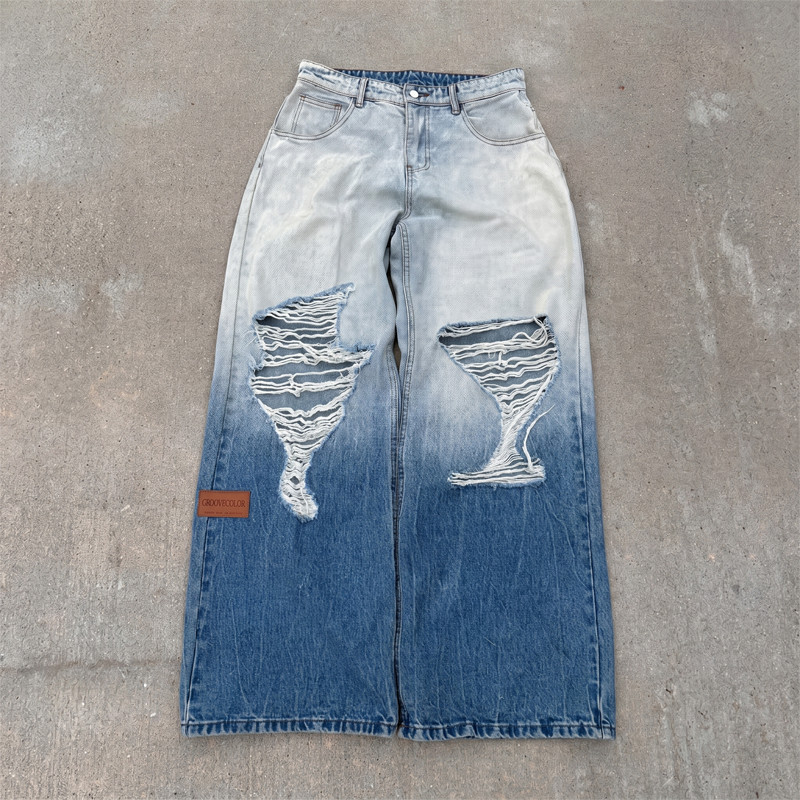
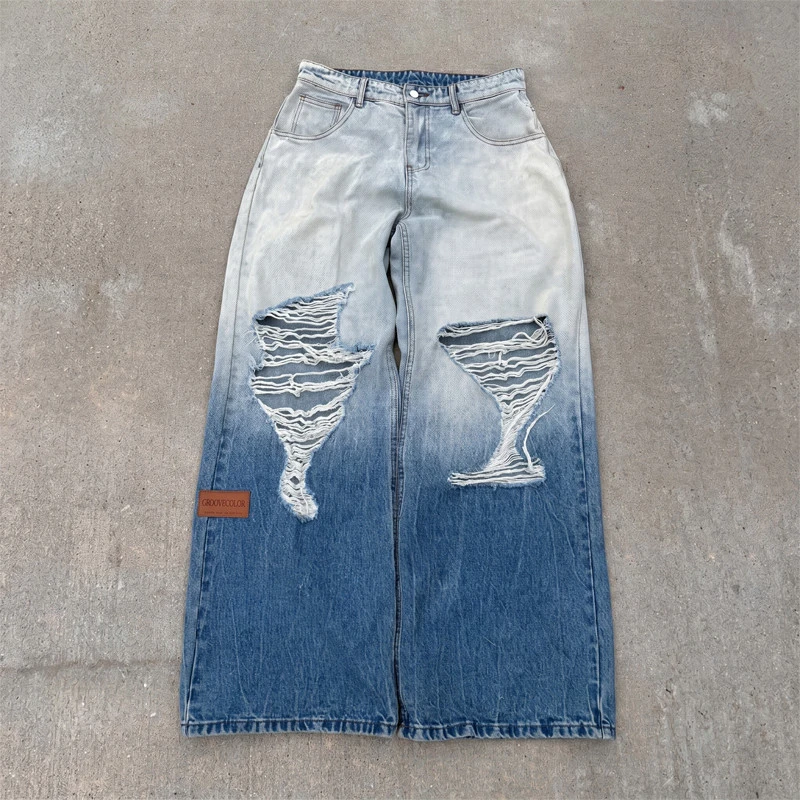
Yes, a manufacturer can produce heavyweight distressed or ripped jeans through planned fabric sourcing, pattern development, controlled abrasion or cutting, and garment finishing. The critical question is whether the chosen denim, rip placement, reinforcement, washing sequence, and quality checks can deliver the approved design across sizes and production orders without undermining the intended fit or garment strength.
A fashion illustration can show an oversized knee opening, faded indigo, exposed white threads, and a heavily stacked leg. It cannot show how those features will react to industrial washing, how the hole will sit on different body sizes, or whether the damaged area will withstand normal handling. Those questions belong to product development, not graphic design alone.
For established streetwear brands, the goal is to turn a distinctive visual concept into a product that can be approved, inspected, delivered, and produced again. This article examines the decisions behind that process, including the type of manufacturing review relevant to a premium OEM streetwear manufacturer such as GROOVECOLOR in Dongguan, China. The emphasis is on technical evidence rather than promotional claims.
What Should Established Streetwear Brands Know Before Producing Ripped Denim?
- ▸ Heavy denim needs to be assessed for weave, yarn behavior, drape, and finishing response. A higher fabric weight alone does not make aggressive distressing safer.
- ▸ Rip placement should be recorded against garment measurements and reviewed across sizes. A hole that looks correct on a flat pattern may move when the jeans are worn.
- ▸ Distressing, washing, and reinforcement must be planned together. Changing the order of these operations can alter the final appearance and the condition of exposed yarns.
- ▸ Sample approval should cover post-wash fit, hole construction, color, trims, and acceptable visual variation, not just whether the first sample looks attractive.
- ▸ Production readiness is established through documented specifications, tested finishing methods, and clear inspection criteria before bulk cutting and processing begin.
Can a Manufacturer Produce Heavyweight Ripped Jeans, or Is the Design Still Only a Mockup?
A heavyweight ripped-jeans design becomes ready for manufacturing review when its fabric, silhouette, distress locations, finishing methods, and construction details can be translated into measurable instructions. A realistic image is useful, but the factory must still determine whether those instructions can be executed without unacceptable damage or unwanted changes to the garment.
Consider a pair of wide-leg jeans with two large openings across the knees, a faded upper thigh, and a raw hem. A design team may treat these as four visual features. A production team sees several linked questions: Can the chosen denim tolerate the abrasion? Will the openings expand during washing? Does the leg still hang correctly after material has been removed? Are the remaining threads strong enough for the approved appearance?
Each answer may change the production route. An open knee hole may need a different treatment from a closed distress panel with retained weft yarns. A sharply faded thigh may be achieved through localized surface treatment, while the surrounding garment requires another finishing step. The workshop should not assume that every worn-looking detail can be created with the same machine or operation.
What should a feasibility review decide?
This four-level review is a practical development framework, not a formal textile standard. It prevents a common mistake: treating a factory's willingness to make a sample as proof that every element of the design has already been validated. Once the concept is defined, the next question is whether the proposed denim can support it.
Which Heavy Denim Fabrics Can Handle Aggressive Ripping Without Losing Their Intended Structure?
The suitable fabric for ripped jeans is determined by more than weight. Yarn structure, weave density, fiber composition, stretch behavior, and finishing conditions all affect how denim breaks, frays, and drapes. Brands should test the selected fabric under the planned process rather than assume that a heavier denim automatically offers greater protection against tearing.
Denim is generally a woven fabric with a twill structure. The construction, yarn characteristics, and dyeing method influence its appearance and behavior during wear and finishing.
A rigid 100% cotton denim can give a wide-leg garment a structured shape. Yet its response to a large cut depends on the yarns that remain around the opening. Stretch denim may offer a different wearing experience, but abrasion can damage both its cotton fibers and elastic components. Neither material should be approved solely from its composition label.
Does higher denim weight make a large knee rip safer?
Not necessarily. A heavier fabric contains more mass per unit area, but this figure does not independently describe resistance to a cut spreading. A dense fabric can feel substantial while still failing locally after severe abrasion. The damage depends on yarn strength, remaining material, direction of force, and how much the finishing process has weakened the area.
Brands commonly compare denim in ounces per square yard, while some technical records use grams per square meter. These are alternative ways to express fabric weight. For example, 14 oz/yd² is approximately 475 gsm. However, two fabrics with the same measured weight can still differ in thickness, yarn arrangement, hand feel, and tear performance.
ASTM D3776/D3776M-20(2025) provides methods for measuring fabric mass per unit area. It does not establish whether a particular pair of distressed jeans is strong enough for its intended use. That requires a separate assessment of fabric properties, garment construction, and the local damage created by finishing.
Fabric approval should answer four questions
▸ Does the original fabric provide the required silhouette and drape?
▸ What happens to the yarns during the proposed abrasion and wash?
▸ How much do the finished color, dimensions, and hand feel change?
▸ Can the fabric source provide the specified material for the planned order?
Established fashion labels should also distinguish available denim from custom-developed fabric. Sourcing from established mills and fabric suppliers may reduce material development work. A special weave, unusual color, or exclusive construction can introduce separate fabric minimums and lead times. GROOVECOLOR's broader approach to streetwear fabric sourcing provides related context, although the availability of any specific denim must be checked for the project.
Once a fabric has been selected, the design team must explain exactly where it intends to remove or expose its yarns. That is where rip placement becomes a technical specification rather than an illustration.
How Should Ripped Knees, Distressed Thighs, and Frayed Hems Be Mapped for Production?
A production-ready rip map identifies each distressed area by location, dimensions, construction type, and approved visual range. It should distinguish open holes from retained-thread effects and include any backing or reinforcement requirements. The factory also needs clear measurement references so the distressing can be reviewed after sewing, washing, and size grading.
A reference image may show a large rip directly over the knee. But that phrase is not enough for production. Does the opening begin above the intended knee line? Is its position measured from the inseam, hem, or another reference point? Does the measurement refer to the garment laid flat, or the position after it is worn?
These decisions affect the cutting and finishing instructions. When the design uses an unusually long rise, lowered crotch, or substantial stacking, the visual knee position may not correspond to the same point on the flat pattern. A technician should not guess where the distressed area belongs from a styled photograph alone.
Which details belong on the rip placement map?
Distress specification checklist
▸ Unique identification for each hole or abrasion area.
▸ Position measured from a defined garment reference point.
▸ Intended width, height, direction, and general shape.
▸ Open-hole, retained-weft, surface-grinding, or repair construction.
▸ Desired edge fraying, exposed yarns, and visible backing details.
▸ Reference photographs and approved limits of visual variation.
▸ Instructions for different sizes and post-wash inspection.
The map should also explain whether exposed white threads are part of the intended design. In traditional indigo denim, warp and weft yarns often have different appearances. Selective removal of surface yarns can reveal lighter threads, while cutting through both systems creates a more open hole. These are different structures, even when the finished photograph appears similar.
An approved photograph and a measurement sheet should work together. The photograph describes the character of the damage. The measurements and construction notes tell the workshop how to position and produce it. The actual sample then shows how the design translates into denim.
This relationship is closely connected to pattern development and garment cutting. The denim pattern determines leg proportions, seam positions, and fabric orientation before any distressing work begins. If those foundations change, the rip map may need revision as well.
After locations and construction types are documented, the manufacturer can determine which processing technique is appropriate for each effect.
Which Distressing Techniques Can Create the Intended Look Without Overworking the Denim?
Distressing methods should be selected according to the physical effect required, not simply the desired vintage appearance. Surface fading, yarn exposure, open holes, and repaired damage involve different manufacturing operations. Laser treatment, manual abrasion, controlled cutting, and garment washing may be combined, but each method must be checked against the fabric and approved finish.
A faded patch and a ripped panel are not the same feature. Fading changes the visible color of the textile. Abrasion removes material from its surface. A cut introduces a deliberate opening. Fraying develops when yarn ends become loose or are worked during finishing. Combining them can produce a rich, worn appearance, but the order and intensity affect the final garment.
Laser systems are especially relevant when a collection uses repeatable localized markings. Jeanologia's garment-finishing technology explains how laser energy can alter the appearance of indigo-dyed denim. However, the presence of laser equipment does not mean that every loose-thread effect or large opening can be produced without additional mechanical or manual work.
CottonWorks also explains that garment finishing includes a broad range of physical and chemical operations. Some wash names describe an appearance rather than a single, universally defined recipe. Therefore, specifying only "vintage wash" or "destroyed finish" leaves too much open to interpretation. See its technical overview of denim garment finishing.
Brands should ask the manufacturer to show which operation creates each visual feature. If the required result combines laser fading, manual yarn exposure, and washing, the production plan should identify those operations separately. GROOVECOLOR's overview of streetwear manufacturing techniques provides additional context on how surface treatments and decorative processes are considered during product development.
Selecting the method is only half the decision. The order in which washing and distressing take place can change the result just as much as the chosen tools.
Should Heavyweight Jeans Be Ripped Before or After Garment Washing?
There is no single distressing sequence suitable for every denim design. Creating an opening before washing can allow the edges to develop additional fraying, while certain localized effects may be more controlled after the main wash. The correct sequence depends on the fabric, treatment intensity, required appearance, and approved sample results.
Industrial washing can soften denim, remove surface color, and alter its dimensions. It can also work on already damaged yarns. A cut that measures correctly immediately after construction may expand or change shape when it undergoes further mechanical treatment. The amount of change cannot be predicted reliably from the photograph alone.
For a design with substantial loose threads, the finishing team may need to develop the edge gradually. For another design, the desired opening may be so defined that creating it after the main wash provides better dimensional control. These are examples of possible routes, not universal instructions. Each route should be checked through trial garments made from the selected material.
What changes when distressing happens before washing?
Pre-wash distressing allows the washing process to interact with the damaged area. This can produce softer edges, movement in exposed threads, and a less mechanically precise appearance. The trade-off is that washing may enlarge the damage or remove more yarn than intended. The outcome depends on wash conditions and the structure that remains around the opening.
What changes when distressing happens after washing?
Post-wash work may make it easier to position a new opening on a garment that has already undergone its main dimensional change. However, the resulting edges may appear sharper or less naturally worn. A second finishing treatment may be needed for the intended appearance, introducing another opportunity for shade or construction changes.
A useful process trial records
▸ The condition and measured dimensions of the garment before treatment.
▸ The operations performed and the order in which they occurred.
▸ The resulting shade, hand feel, hole size, and exposed-thread appearance.
▸ Whether another operation or design adjustment is necessary.
A successful trial should result in a written process route and an approved physical reference. If the wash is later changed, the effect on the damaged panels should be reviewed again. This is particularly important when the garment also contains custom hardware, labels, or repair patches that may react differently to treatment.
Once the wash sequence is defined, the next issue is structural: whether the remaining yarns and any repair construction can support the intended garment.
How Can a Factory Reinforce Large Rips Without Losing the Distressed Look?
Large denim openings may be supported through retained yarns, backing fabric, repair patches, or controlled stitching, depending on their location and intended appearance. Reinforcement should protect the design's usable structure without changing its visual character unnecessarily. The method must be approved through sample review, especially around areas exposed to repeated bending or pulling.
Not every hole needs a patch. Some designs intentionally expose a wide open section. Others rely on rows of remaining white threads that form part of the visual identity. The correct construction depends on whether the garment is designed to expose skin, show loose threads, reveal a contrasting layer, or create a repaired archival appearance.
Placement matters. A large opening across the knee is exposed to repeated flexing when the wearer sits, bends, or walks. An abrasion near a pocket opening or side seam may affect an area that already carries tension. A decorative repair patch can help manage a particular design, but its attachment must also be reviewed for comfort and movement.
Which reinforcement details should be specified?
A technical pack should identify the backing material where used, its placement, attachment method, visible edges, and any stitch requirements. The team should also decide whether a patch may be visible from the outside. If the backing has a different shrinkage response from the denim, the completed area may pull or distort after treatment.
A heavy repair fabric is not automatically better. Excessive thickness can create a stiff patch on an otherwise soft garment. A lighter backing may feel more comfortable but might not provide the required support. These are design trade-offs to be tested, not decisions that can be settled by fabric weight alone.
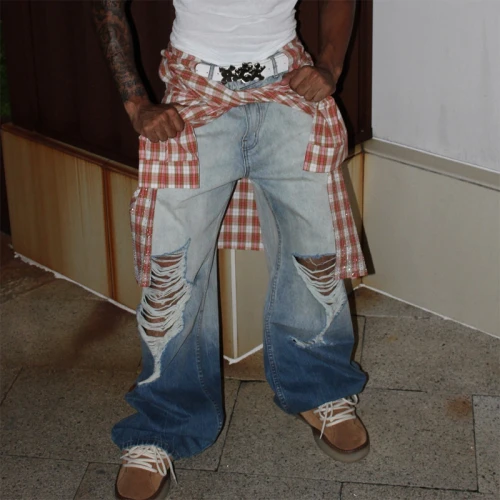
Where strength needs formal evaluation, the material and proposed test must be defined. ASTM D1424-25 describes a method for measuring fabric tearing strength with a falling-pendulum apparatus. It does not establish the complete service life of jeans containing an intentionally damaged knee. Garment-level inspection and use-related evaluation remain necessary.
After the reinforcement is approved, the factory must still determine how the same visual design should sit on the different sizes within a commercial order.
How Do Baggy Fits and Size Grading Change the Placement of Rips?
Rip placement should be reviewed alongside the jeans pattern and size grading because the location of a distressed panel can shift in relation to the body. Wide-leg shapes, longer rises, and stacked hems make flat measurements less reliable as visual guides. Brands should approve the intended position on representative sizes after finishing.
A knee opening positioned correctly on a medium-size sample may look different on an extra-large garment. The rise, inseam, knee width, leg opening, and overall length may change at different rates. Simply enlarging the distress shape or moving it by the same amount as the hem does not always preserve the intended visual placement.
Baggy jeans introduce another variable: excess fabric moves around the leg. On a wide silhouette, a large distressed area may rotate slightly with the garment or sit below the wearer's anatomical knee. On stacked jeans, folds near the lower leg can influence how the overall design appears in a full-body photograph.
Should every size use exactly the same rip coordinates?
The answer depends on how the design is graded. Some distressed details can be assigned a fixed relationship to a seam or garment measurement. Others require a size-specific position or proportion. The correct choice should be documented after reviewing the pattern and at least the sizes most likely to reveal a placement problem.
Fit review should consider the garment both flat and worn. Flat measurements are essential for production inspection. Wear trials reveal whether the distressing appears in the intended location when the trousers are moving. These two forms of assessment answer different questions and should not be treated as substitutes.
If the size range includes substantially different leg proportions, the brand may approve more than one distress-placement reference. The manufacturer should record which reference applies to which sizes instead of expecting workshop operators to make informal adjustments during production.
With fabric, processing, reinforcement, and grading decisions in place, a physical sample must demonstrate that the full design works as a garment.
What Must a Heavyweight Ripped Jeans Sample Prove Before Bulk Production?
A distressed denim sample should confirm the finished fit, surface appearance, damaged-area construction, and production specifications. Approval should include measurements after the intended finishing process, an agreed reference for acceptable visual variation, and confirmation of critical trims. A sample that photographs well is not sufficient if these production decisions remain unresolved.
For established streetwear collections, sample approval has a commercial purpose. The design must work with the product's retail positioning, size offering, and planned delivery. If a rip becomes much larger after washing or a repaired panel causes discomfort, those problems should be discovered before the production order is released.
A useful approval process divides the evaluation into distinct decisions. The first checks the silhouette and finished measurements. The second examines distressing and shade. The third reviews the local construction and trims. The final decision determines whether the factory has adequate information to begin production.
These gates are proposed management checkpoints, not an industry certification system. A brand may adapt them to its development calendar. Their value lies in separating aesthetic approval from technical approval so that unresolved issues are not concealed within one general sign-off.
The physical sample should be kept or clearly referenced in the production record. Photographs are useful for communication, but lighting and image processing can alter the perceived shade and texture. If the garment contains hand-distressed details, the approval record should explain the expected variation rather than requiring every individual yarn to occupy an identical position.
Once the sample has been approved, the factory needs inspection criteria that distinguish intentional damage from defects introduced during production.
Which Quality Checks Can Separate Intentional Distressing from Unacceptable Damage?
Quality control for ripped jeans must distinguish approved design damage from unintended manufacturing defects. Inspectors should use the physical reference, rip map, construction instructions, and finished measurement specifications. The inspection must examine both visible distressing and less obvious issues such as damaged seams, loose reinforcement, incorrect hardware, and unwanted dimensional changes.
A raw edge is not automatically defective. Neither is a visibly irregular opening. If these features were approved, their presence is part of the product. The problem arises when the garment falls outside the accepted design range, or when processing causes damage in an area that was supposed to remain intact.
Inspectors need more than a general instruction to "check the rips." They should know which dimensions matter, which threads are expected to remain, where reinforcement must appear, and how the finished color relates to the approved reference. This enables inspection decisions to be based on agreed requirements rather than personal aesthetic judgment.
Examples of different inspection outcomes
Accepted feature: A frayed knee opening falls within the approved shape and size range.
Requires review: An opening is visibly larger than the reference, but its status depends on the agreed tolerance.
Unacceptable defect: A seam or repair attachment is damaged beyond the approved construction specification.
Requires measurement: The washed garment appears shorter or narrower than the approved fit.
Which textile tests are relevant to finished denim?
Textile tests should be chosen for the actual question being investigated. Fabric weight measurement does not replace tear testing. Tear testing does not replace finished garment inspection. Likewise, a garment's response to laundering is a different question from its color change during a specific industrial wash process.
AATCC TM150 addresses dimensional changes of garments after home laundering. AATCC also publishes methods related to colorfastness, including laundering performance. These recognized methods can guide a test plan when their scope matches the project. They should not be presented as automatic pass-or-fail requirements for every denim order.
The sampling plan and acceptance limits should be agreed in advance. Where AQL inspection is used, defect classifications must be adapted to the product's approved appearance. A standard designed for conventional, undamaged trousers cannot simply be copied onto an intentionally destroyed denim style without defining the differences.
GROOVECOLOR's garment quality-control process describes broader checks across manufacturing stages. For a distressed denim program, those checks need product-specific instructions covering the approved wash, exposed yarns, repair work, measurements, and final appearance.
Clear inspection requirements also influence costing. A style that needs repeated manual handling, several finishing stages, and detailed visual checking should not be priced as though it were a straightforward sewn garment.
Why Can Two Ripped Jeans Styles with the Same Denim Weight Have Very Different Production Costs?
The cost of custom distressed jeans depends on more than denim weight and fabric consumption. Each additional treatment can affect processing time, labor, repair materials, washing, inspection, and production planning. Two garments made from similar denim may therefore require different quotations because their distressing complexity and approval requirements are substantially different.
Imagine two jeans styles using the same base fabric. One requires a faded thigh and a small, controlled knee abrasion. The other has multiple open holes, loose retained yarns, individual backing panels, extensive vintage washing, and custom metal trims. Their starting material may be similar, but the second design requires more separate work and a more involved inspection plan.
Manual distressing introduces labor requirements. Laser finishing may involve machine operation and program development. Repair panels add material, cutting, and attachment work. Multiple treatments can increase handling and may require extra sample trials. None of these elements should be assigned a fixed universal price without understanding the proposed production route.
Which design decisions most affect the quotation?
The quantity of distressed areas matters, but so does their complexity. A single large opening with retained threads and concealed reinforcement may require more careful work than several simple surface abrasions. The number of colors, fabric sources, wash variations, size groups, and special trims can also change how the order is organized.
Production quantity affects cost allocation, but not every processing method becomes practical at the same volume. A design needing exclusive fabric or specialized equipment may carry conditions different from a style using available denim and familiar finishing operations. A manufacturer should explain those conditions before the brand confirms its range plan.
For mature brands, a strategic test run can be valuable when it verifies a new treatment before a larger order. It should be planned around a defined approval objective rather than treated as evidence that any complex design can be produced at an arbitrary quantity. The required order size remains subject to the selected fabric, processing route, and production schedule.
Before comparing quotations, procurement teams should ask each factory to identify what is included: base garment construction, distressing, washing, reinforcement, hardware, labels, testing, packing, and freight terms. Comparing incomplete quotations can conceal meaningful differences in the actual work.
Cost is also linked to the way the finishing process is managed. Brands should understand who performs each operation and what evidence supports the proposed method.
How Can Brands Verify That a Denim Factory's Finishing Process Is Suitable and Responsible?
A responsible denim production review should identify the finishing methods, the parties carrying them out, and the evidence available for process control and worker protection. Brands should not treat the presence of modern equipment as proof of environmental performance. Suitability depends on the actual treatment, working conditions, documented controls, and product results.
Complex denim production may involve several specialized operations. Pattern development, sewing, washing, laser treatment, local abrasion, repair construction, and final inspection do not always occur in the same department or facility. Brands should establish which organization is responsible for each step and how the approved specifications are transferred between them.
The handover is especially important when one process changes the result of another. A finishing partner may receive a correctly sewn garment but lack the latest distress-placement revision. A repair team may work from an old photograph rather than the approved sample. Document control helps prevent these avoidable errors.
Why should traditional sandblasting claims be examined carefully?
Worker safety is a central issue in certain denim finishing methods. In 2010, Levi Strauss & Co. announced a global ban on sandblasting across its product lines because of serious health risks associated with silica exposure. This historical decision remains relevant when evaluating how distressed effects are produced.
Alternative technologies, including laser and ozone treatment, may help replace certain conventional operations. But their performance and resource requirements depend on equipment, process conditions, and the finishing result. Claims about water savings, reduced chemical use, or emissions should be supported by data for the specific process, not copied from an unrelated machine demonstration.
An apparel team should ask for the proposed finishing route, responsible facility information, available audit evidence, and relevant inspection or testing records. If a process is performed by a specialist partner, that should be disclosed rather than presented as an unverified in-house capability.
GROOVECOLOR also provides a broader account of responsible streetwear manufacturing practices. For any individual denim project, the applicable material records, finishing methods, and audit documents should be assessed on their own merits.
These checks lead to a practical sourcing decision: what type of manufacturing operation can manage the project from technical review through finished garment inspection?
What Manufacturing Capabilities Should a Brand Verify Before Assigning a Complex Denim Order?
The right manufacturing operation is one whose technical and production resources match the design's risks. For complex denim, the important capabilities include pattern review, fabric verification, distressing trials, process coordination, documented approval, and finished-garment inspection. Factory size and attractive sample photography are useful context, but neither replaces evidence of these controls.
A sewing-focused facility may be capable of making the base jeans while relying on a specialist finishing partner for complex washing. Another operation may provide more finishing services directly. Neither arrangement is automatically superior. The sourcing question is whether the handovers, process responsibility, technical communication, and inspection records are adequate for the particular design.
Procurement teams should request evidence that relates to the proposed product. A factory's experience with basic five-pocket jeans is relevant to construction, but it does not by itself establish the ability to execute large distressed panels after aggressive washing. Conversely, expertise in surface fading does not automatically demonstrate the ability to develop a balanced oversized jeans pattern.
What evidence should sourcing teams ask to examine?
Relevant evidence may include comparable physical samples, a clear description of the process route, fabric specifications, technical pack review records, approved wash references, grading examples, and quality inspection procedures. The depth of evidence needed depends on the novelty and complexity of the design.
A useful factory review should also identify the point at which material substitutions or process changes require fresh approval. If the original denim becomes unavailable, replacing it with another fabric of similar weight does not mean the existing distressing method will produce the same result. The new material may react differently during washing or abrasion.
For brands planning repeat collections, manufacturing records matter because they help teams understand what was approved previously and which parts of the process may need further review. The focus should be on preserving an agreed production reference, not claiming that individually distressed garments can be made visually identical.
GROOVECOLOR publishes information about its OEM bulk production capabilities. Capacity information may help with supplier qualification, but project-specific availability, specialist finishing requirements, and delivery planning still need to be confirmed before an order is accepted.
The best way to obtain a useful feasibility response is to give the manufacturer a technical brief that makes the unresolved decisions visible.
What Should Your Team Include in a Heavyweight Ripped Jeans Manufacturing Brief?
A useful manufacturing brief should identify the intended silhouette, denim specifications, distressing locations, repair construction, finishing references, size range, quantity plan, and approval requirements. It should also separate confirmed instructions from details that still need development. This allows the manufacturer to assess feasibility and quote the actual work rather than make assumptions.
The core document is a technical pack containing the front and back garment views, measurement points, grading requirements, seam details, pockets, closures, and trims. For distressed denim, add separate artwork or diagrams identifying the location and intended form of each damaged area. The standard garment drawings and distressing map should use compatible reference points.
Include fabric information as precisely as possible: preferred composition, target weight, rigidity or stretch requirements, color, surface texture, and any known finishing limitations. If the brand is providing a physical reference garment, explain which characteristics must be matched and which are only general inspiration.
Recommended submission package
▸ Complete tech pack with finished garment measurements.
▸ Front and back views showing every distress location.
▸ Rip dimensions, edge details, and reinforcement requirements.
▸ Fabric composition, target weight, and color references.
▸ Wash, fading, and finish references or approved physical samples.
▸ Size breakdown, quantities by style and color, and planned delivery market.
▸ Custom trim, label, packaging, and inspection requirements.
Mark decisions that remain open. For example, the brand may have approved the silhouette but not yet decided whether the knee holes need visible backing. That uncertainty should be identified rather than silently resolved by the factory. Clear development questions lead to better sample proposals and more meaningful quotations.
An established menswear label may already have a preferred fit block or past-season measurements. Providing those records can reduce unnecessary discussion. However, the new denim and finishing treatment must still be reviewed because a previous pattern does not guarantee the same finished dimensions with a different material.
A complete submission is the basis for comparing a manufacturer's actual capability against the proposed design. It also provides a practical starting point for a GROOVECOLOR project review.
What Can GROOVECOLOR Review Before Accepting a Heavyweight Ripped Jeans Project?
GROOVECOLOR is a premium OEM streetwear manufacturer in Dongguan, China, serving established streetwear brands and menswear-focused labels with structured custom development needs. Its relevant manufacturing scope includes denim and streetwear pants, fabric sourcing, pattern development, distressing-related finishing, sampling, and bulk production management. Exact project feasibility depends on reviewing the proposed specifications and processing requirements.
GROOVECOLOR reports more than 16 years of streetwear manufacturing experience and a broader production capacity exceeding 300,000 garments per month. Those figures describe the company's general operations. They should not be interpreted as a specific monthly capacity for highly distressed denim jeans, which may require separate finishing resources, manual operations, and project scheduling.
For this type of project, the relevant questions begin with the selected denim, the relationship between the pattern and rip positions, and the proposed washing sequence. They continue through sample approval, repair construction, trim selection, and inspection criteria. Any specialized treatment that requires an external processing partner should be confirmed as part of the actual manufacturing plan.
The company's custom denim pants category provides an overview of its relevant product range. For a specific development, product references should be used to discuss design possibilities rather than treated as a guarantee that the same finish can be achieved on every fabric or within every order plan.
The most suitable projects are those with a clear brand direction, defined product specifications, and a commercial plan for custom garment development. For procurement and product teams, the immediate value of a manufacturer review is learning which details can move directly to sampling, which need adjustment, and which require further technical verification.
Ultimately, the approved garment should reflect the design intent while also giving the production team a workable set of instructions. Several questions tend to remain even after the initial specifications have been reviewed.
Which Ripped Jeans Production Questions Should Be Settled Before Bulk Approval?
These questions focus on the technical decisions most likely to affect a custom distressed denim order. Exact acceptance limits should be agreed for the selected design and material.
Can heavyweight denim develop larger holes after garment washing?
Yes. Washing and mechanical movement can further disturb yarns that have already been cut or abraded. The outcome depends on fabric construction, the original opening, treatment conditions, and any reinforcement. Brands should compare the opening before and after trial processing and approve a finished reference rather than rely only on the original cut dimensions.
Does a large knee rip always need a backing patch?
No. Backing is a design and construction decision, not an automatic requirement for every large opening. Some styles intentionally expose skin, while others need retained threads or a supporting layer. The factory should review the opening size, location, expected movement, and target appearance before selecting a repair method.
Can a manufacturer preserve white weft threads across a ripped knee?
Often, yes, when the chosen denim construction and distressing method permit selective yarn removal. The number and condition of retained threads will depend on the material and subsequent finishing. A reference sample should establish the intended appearance and the acceptable amount of natural variation.
Can laser distressing produce a real frayed hole rather than only a faded graphic?
Laser equipment can create localized effects and, with suitable settings, may contribute to actual material damage. However, producing a loose, natural-looking frayed opening can require further mechanical treatment or manual work. The result must be checked on the chosen fabric because equipment capability and yarn response vary.
Should rip locations change between size M and size XL?
They may need to change because garment proportions and the intended knee position can differ across sizes. The grading plan should explain whether each distressed area follows a fixed seam reference or a size-adjusted position. Representative wear reviews can help confirm the intended placement.
Can black and indigo denim use the same distressing process?
Not necessarily. Color, dyeing method, fabric construction, and finishing history can affect how denim responds to abrasion or washing. Even when two fabrics have similar weight, a treatment developed for indigo denim should be checked before it is applied to a black version.
What if the bulk denim feels different from the approved sample fabric?
A material difference should trigger a review before the approved finishing method is used without changes. Fabric composition, weight, weave, and prior treatments may influence the final feel and damaged appearance. The team should compare the new material with the approval record and determine whether another trial is needed.
Can repair patches be concealed without changing the visible design?
Some backing arrangements can be made less visible, but their effect on thickness, movement, and the opening must still be reviewed. Stitch placement, patch color, backing size, and laundering behavior all matter. A physical sample is the appropriate basis for accepting the construction.
How much variation is acceptable between two hand-distressed jeans?
The acceptable range should be defined by the brand and manufacturer using approved samples and inspection instructions. Some differences in loose threads and surface wear may be intentional. Placement outside the allowed area, damaged seams, or unsupported openings may instead require corrective action.
Can one jeans design include different levels of distressing?
Yes, provided the different finishes are clearly defined and approved as separate production requirements. A collection may include lighter abrasion and more heavily damaged versions. The factory should identify the operations, sample references, inspection criteria, and production quantities associated with each version.
What happens if a rip exceeds the approved size after testing?
The result should be compared with the agreed specification before the process is released for production. Depending on the cause, the team may adjust the initial opening, treatment intensity, reinforcement, or fabric choice. If the change alters the approved appearance or construction, a new sample review is appropriate.
Can GROOVECOLOR review a distressed denim design before final pricing?
A preliminary manufacturing review can identify the information needed for sampling and a detailed quotation. The review should consider the technical pack, selected denim, finishing references, quantities, and special trims. Final pricing and the proposed production route depend on confirming the actual scope of work.
What Should Brands Take Away from This Manufacturing Review?
Heavyweight ripped jeans are not difficult simply because they contain visible damage. They become demanding when the design requires several linked manufacturing decisions: fabric selection, cut-and-sew construction, intentional yarn removal, finishing, grading, and inspection.
A successful development process gives each of these decisions a clear reference. It also recognizes that some visual variation is natural in distressed products while unintended structural damage remains unacceptable.
For established streetwear labels, the most useful question is not whether a factory can produce one striking sample. It is whether the approved design has been translated into a technically workable product with documented requirements for manufacturing and future production orders.
Technical References and Further Reading
The following sources support the fabric, finishing, and testing concepts discussed above. The manufacturing decision frameworks are editorial recommendations and should be adapted to each project.
- ASTM International — D3776/D3776M-20(2025): Fabric Mass per Unit Area.
- ASTM International — D1424-25: Fabric Tearing Strength.
- AATCC — TM150: Dimensional Changes of Garments after Home Laundering.
- AATCC — Textile Testing Standards and Procedures.
Share your tech pack, denim specifications, distress-placement drawings, finishing references, and planned production quantities with GROOVECOLOR. A project review can help identify feasible construction options, development tests, and the information needed before sample approval and bulk production planning.
Explore GROOVECOLOR OEM ManufacturingAbout the Author
