How Do Streetwear Brands Find a Rhinestone Hoodie Manufacturer That Actually Delivers at Scale?
- Share
- publisher
- GROOVECOLOR
- Issue Time
- Mar 5,2026
Summary
How do streetwear brands find a rhinestone hoodie manufacturer that delivers at scale? This guide covers hot-fix adhesion methods, fabric engineering (350-400 gsm blends), factory vetting benchmarks, OEM vs ODM models, pricing structures, and quality control systems for crystal-embellished hoodies. Backed by ASTM testing standards, McKinsey sourcing data, and 16 years of Groovecolor production experience in Dongguan, China. For established brands scaling rhinestone hoodie programs.
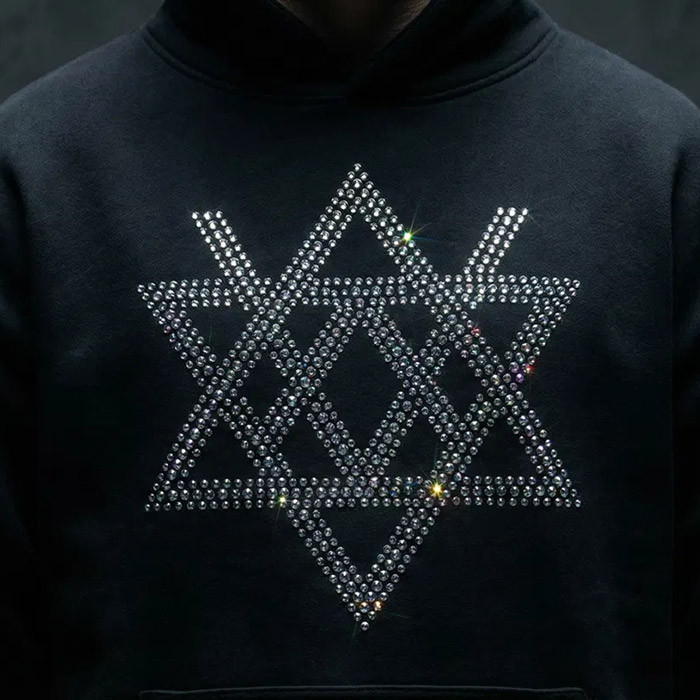
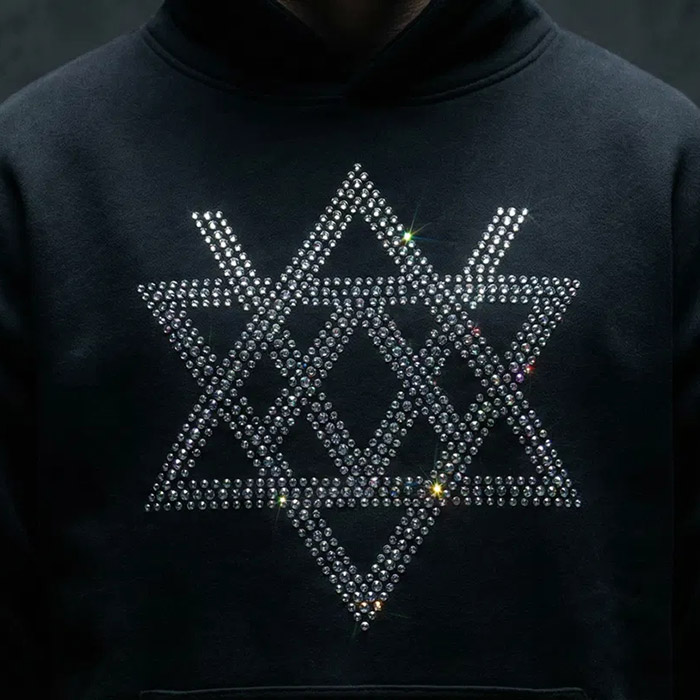
Finding a rhinestone hoodie manufacturer capable of translating a flawless sample into thousands of consistent, durable, retail-ready units is the single most consequential sourcing decision a growth-stage streetwear brand will make in 2026. The global streetwear market reached an estimated USD 371.09 billion in 2025 and is projected to climb to USD 734.05 billion by 2034, growing at a CAGR of 7.95%, according to Fortune Business Insights. Within that expansion, rhinestone-embellished hoodies have emerged as one of the highest-margin, highest-risk product categories—driven by celebrity endorsements, Y2K nostalgia, and a consumer appetite for tactile, statement-making garments. Yet the gap between a visually stunning prototype and a commercially viable bulk order remains the number-one reason brands lose money on embellished collections. This guide, informed by Groovecolor’s 16-year track record in complex streetwear manufacturing, walks established brand owners and procurement teams through every decision gate—from adhesion method selection and fabric engineering to factory vetting, production timelines, and scaling strategy—so you can source with confidence rather than hope.
Key Takeaways for Streetwear Brands
- ▸ Hot-fix rhinestone adhesion on heavyweight cotton-polyester blends (350–400 gsm) delivers the strongest wash durability—properly applied stones can survive 50+ wash cycles when temperature, pressure, and dwell time are factory-calibrated.
- ▸ A rhinestone hoodie tech pack must include 1:1-scale placement templates, stone size and type specifications, adhesion method requirements, and wash-test benchmarks—incomplete documentation is the leading cause of bulk production failures.
- ▸ China-based manufacturers in Dongguan and Guangzhou dominate rhinestone hoodie production due to vertically integrated supply chains, specialized hot-fix equipment, and deep experience with complex embellishment workflows.
- ▸ Systematic factory vetting—covering rhinestone application consistency, wash durability testing, fabric compatibility, and export compliance—separates reliable manufacturing partners from sample-only operations that collapse under volume.
- ▸ Scaling from 500-piece test runs to 5,000+ unit programs requires batch-level quality locking, redundant supplier networks, and a manufacturer whose production logic is purpose-built for embellished streetwear—not generic cut-and-sew.
Why Is the Rhinestone Hoodie the Highest-Stakes Product in Your Streetwear Line?
Rhinestone hoodies sit at the intersection of peak consumer demand and peak manufacturing complexity, making them simultaneously the biggest revenue opportunity and the biggest quality risk in any streetwear collection. Since mid-2024, rhinestones have moved from fitted hats and accessories into mainline apparel. Complex reported that brands from Supreme to Denim Tears have incorporated crystal elements across hoodies, sweatpants, and outerwear, fueled by endorsements from artists including Lil Yachty, ASAP Rocky, and Kendrick Lamar. The rhinestone itself—originally a glass imitation gemstone from the Rhine River region—has been reimagined through modern hot-fix adhesive technology into a durable, scalable embellishment suitable for mass production.
The market data reinforces the opportunity. The global rhinestone market was valued at approximately USD 1.5 billion in 2024 and is estimated to reach USD 2.5 billion by 2033, growing at a CAGR of 6.2%, according to Verified Market Reports. In Europe alone, rhinestone-adorned products have achieved a 25% annual growth in market share. For streetwear brands, this translates into a clear commercial signal: consumers are willing to pay premium prices for embellished garments, but only when the execution is flawless. A rhinestone hoodie with stones falling off after three washes does not just cost you a return—it costs you a customer and a reputation.
What makes this product category uniquely high-stakes is the manufacturing complexity hidden behind the visual appeal. Unlike screen-printed or embroidered hoodies, rhinestone garments require the manufacturer to bond rigid decorative elements to soft, flexible fabric—and maintain that bond through repeated washing, stretching, and wear. The adhesion process demands precise temperature control (typically 335°F / 168°C for hot-fix stones), calibrated pressure, and fabric substrates engineered to accept adhesive without compromising hand feel. When any one of these variables drifts during bulk production, the result is inconsistent stone placement, adhesion failure, or fabric distortion—problems that are invisible in a sample room but devastating at scale.
What Separates a Rhinestone Hoodie Sample from a Commercially Viable Bulk Order?
The gap between a perfect rhinestone hoodie sample and a commercially viable bulk order is defined by three variables: adhesion method selection, substrate engineering, and placement repeatability—and most manufacturers fail on at least one when volume increases. In the sample room, a skilled technician can hand-place every stone with surgical precision. In bulk production, that same design must be replicated across hundreds or thousands of units by multiple operators, using industrial heat-press equipment, on fabric that may vary slightly in weight, shrinkage, and surface texture from roll to roll.
How Do the Three Rhinestone Application Methods Compare for Bulk Production?
Understanding the adhesion method is the first decision gate. According to manufacturing analysis embellishment specialists, three primary methods dominate commercial rhinestone hoodie production, each with distinct implications for cost, durability, and design flexibility.
For most growth-stage streetwear brands producing at volumes of 200–5,000 units per style, hot-fix rhinestone application represents the optimal balance of durability, design flexibility, and cost efficiency. The process uses industrial-grade adhesive pre-applied to the back of each stone, activated by a heat press at controlled temperature (330–340°F), pressure (40–60 PSI), and dwell time (12–15 seconds). When these parameters are locked in and monitored across every production run, hot-fix stones deliver wash durability exceeding 50 cycles—a benchmark referenced by multiple manufacturers and aligned with ASTM textile testing standards for embellishment adhesion.
What Fabric Weight and Composition Works Best for Rhinestone Adhesion?
Fabric selection is not a secondary consideration—it is a structural prerequisite. A medium to heavyweight cotton-polyester blend in the 350–400 gsm range is widely recommended by experienced rhinestone hoodie manufacturers. The cotton component provides a porous bonding surface that accepts hot-fix adhesive effectively, while the polyester content adds dimensional stability and reduces shrinkage that could stress adhesion points over time. Pure cotton substrates above 380 gsm can work, but they carry higher shrinkage risk during garment washing, which may compromise stone placement accuracy. Brands working with advanced streetwear washing workflows—acid wash, enzyme wash, or stone wash—must factor in post-wash fabric behavior when specifying rhinestone placement zones.
How Should You Specify Rhinestone Placement in Your Tech Pack?
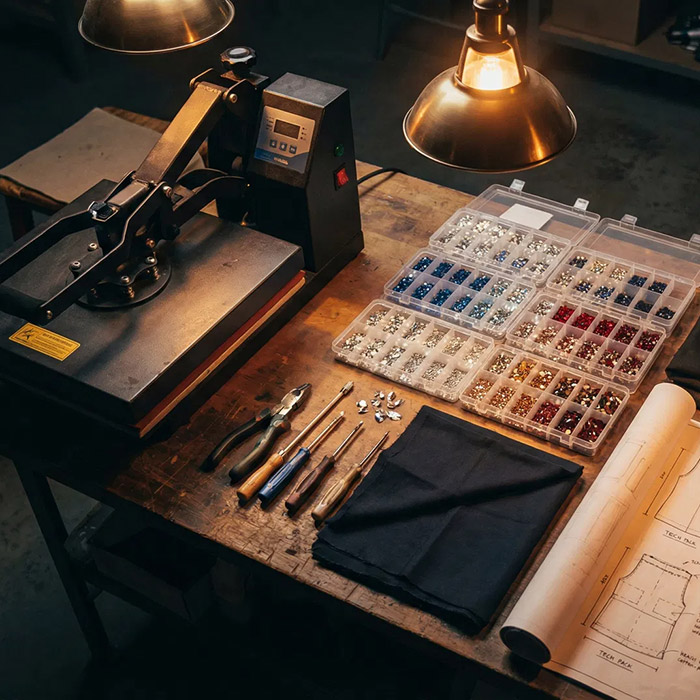
A rhinestone hoodie tech pack must go beyond standard garment documentation. In addition to flat sketches, size grading, and construction details, it must include a separate 1:1-scale rhinestone placement template specifying stone size (SS6 through SS40), type (glass crystal vs. acrylic), color codes, spacing tolerances, and adhesion method requirements. The tech pack should also define wash-test benchmarks—minimum cycle count, water temperature, and acceptable stone loss rate. Brands that invest in comprehensive tech pack preparation, as outlined in resources like detailed tech pack guides for bulk streetwear manufacturing, consistently report fewer sampling revisions and lower bulk rejection rates.
How Do You Vet a Rhinestone Hoodie Manufacturer Before Committing to Bulk?
Vetting a rhinestone hoodie manufacturer requires evaluating capabilities that most generic factory audits overlook: rhinestone application consistency across operators, wash durability under production conditions, and the ability to maintain stone placement accuracy at volumes exceeding 500 units per run. Standard apparel factory audits, such as those outlined by Groovecolor's factory visit checklist, cover essential ground—production capacity, machinery, safety protocols, and compliance certifications. But for rhinestone-embellished garments, the audit must extend into territory that separates embellishment-capable factories from embellishment-specialized ones.
What Are the Non-Negotiable Quality Benchmarks for Rhinestone Hoodies?
Before placing any bulk order, your manufacturer must demonstrate compliance with measurable quality benchmarks. At minimum, request documentation or live demonstration of the following: heat-press calibration records showing consistent temperature (within ±5°F of target), pressure uniformity across the platen surface, and dwell-time accuracy. Ask for wash-test reports from previous rhinestone hoodie production runs—specifically, stone retention rates after 20, 30, and 50 wash cycles at 30°C. A manufacturer that cannot produce these records is operating on intuition rather than process control, which is a structural risk at scale. The Fashion Revolution Transparency Index underscores the growing industry expectation that manufacturers maintain auditable, documented quality systems.
How Do You Test Rhinestone Durability Before Placing a Bulk Order?
Never approve bulk production without conducting independent durability testing on pre-production samples. The testing protocol should include: wash testing (minimum 20 cycles at the care-label temperature), stretch testing on seam-adjacent areas where fabric movement is greatest, adhesion pull testing using a calibrated force gauge, and visual inspection under multiple lighting conditions to detect placement drift. These methods align with principles established in ASTM textile testing frameworks. If your manufacturer resists providing samples for independent testing, treat that resistance as a disqualifying signal.
What Red Flags Should You Watch for During Factory Communication?
Communication patterns during the quoting and sampling phase reveal more about a manufacturer’s capabilities than any marketing material. Watch for these warning signs: inability to specify which adhesion method they use (or defaulting to “we can do any method” without technical detail), reluctance to share wash-test data from previous orders, vague answers about fabric sourcing and GSM consistency, and quoting timelines that seem unrealistically fast for rhinestone work. Experienced manufacturers will proactively ask about your stone specifications, placement complexity, and wash requirements—because they understand that these variables directly affect production planning. Factories that treat rhinestone hoodies as “just another hoodie with decoration” are signaling a lack of specialized capability. For a deeper evaluation framework, procurement teams can reference structured vetting checklists designed for hoodie manufacturer evaluation.
Should Your Brand Go OEM or ODM for Rhinestone Hoodie Production?
For rhinestone hoodies specifically, OEM (Original Equipment Manufacturing) is the preferred model for established brands that need unique designs and full creative control, while ODM (Original Design Manufacturing) suits brands seeking faster market entry with modified existing templates. The distinction, as defined by the OEM manufacturing model, centers on who owns the design intellectual property and who controls the production specifications. In rhinestone hoodie production, this decision has outsized consequences because the embellishment design—stone layout, density, color combinations—is often the primary differentiator between a brand’s hero product and a generic embellished garment.
When Does OEM Make More Sense Than ODM for Rhinestone Hoodies?
OEM is the right path when your brand has a defined aesthetic identity, an in-house or contracted design team capable of producing detailed tech packs, and the volume to justify custom pattern development. Under the OEM model, you provide complete specifications—from fabric weight and construction to rhinestone placement templates—and the manufacturer executes to your exact standards. This gives you full IP ownership and the ability to create truly exclusive designs that competitors cannot replicate. The trade-off is that OEM requires stronger design resources on your side and typically involves longer sampling cycles, as every element is built from scratch. For brands navigating this decision, a detailed comparison of OEM versus ODM production models for premium streetwear can clarify which structure aligns with your operational maturity.
How Does the Private Label Model Work for Embellished Streetwear?
Private label manufacturing for rhinestone hoodies operates as a hybrid: the manufacturer provides base hoodie construction and may offer a catalog of rhinestone design templates that brands can modify, rebrand, and customize with their own labels, tags, and packaging. This model accelerates time-to-market but limits design exclusivity. For brands with proven sell-through on embellished products looking to test new rhinestone styles before committing to full OEM development, private label can serve as a strategic test mechanism. The key is ensuring your private label partner maintains the same quality control rigor as a full OEM operation—because the consumer does not distinguish between how the product was sourced, only how it performs.
What Does the Ideal Production Timeline Look Like for a Rhinestone Hoodie Collection?
A realistic rhinestone hoodie production timeline from final tech pack submission to delivery runs 8–12 weeks, with the factory-side window typically spanning 5–8 weeks—longer than standard hoodies due to additional embellishment steps and mandatory quality testing. According to McKinsey’s State of Fashion 2025 report, the broader apparel industry faces increasing pressure to compress lead times while maintaining quality, a tension that is particularly acute for embellished garments where rushing the adhesion or curing process directly compromises durability.
How Long Does Rhinestone Hoodie Sampling Really Take?
Sampling for rhinestone hoodies typically requires 2–3 weeks for the initial prototype, with an additional 1–2 weeks for revisions. This timeline assumes a complete, detailed tech pack. If your tech pack lacks rhinestone placement specifications or wash-test requirements, expect the sampling phase to extend by 1–3 weeks as the manufacturer works through design clarifications. The sampling phase for rhinestone work is inherently longer than for standard hoodies because the manufacturer must source specific stone types, calibrate adhesion equipment for your chosen substrate, and produce test pieces for wash-durability validation before presenting the final sample.
What Are the Most Common Delays in Rhinestone Hoodie Production?
Three delay categories account for the majority of timeline overruns in rhinestone hoodie production. First, stone sourcing delays: specific rhinestone types (Preciosa, Swarovski-equivalent glass crystals, or custom-color acrylic stones) may have lead times of 2–4 weeks, especially for non-standard sizes or colors. Second, adhesion testing failures: if the initial adhesion test reveals inadequate bond strength on the chosen fabric, the manufacturer must adjust temperature, pressure, or adhesive formulation and re-test—a process that can add 1–2 weeks. Third, quality control bottlenecks: rhinestone placement inspection is more labor-intensive than standard garment QC, requiring visual verification of every stone position on every unit. Manufacturers without dedicated embellishment QC teams often experience backlogs at this stage.
How Should You Structure Your Production Calendar Around Drop Dates?
Work backward from your drop date with built-in buffer. If your target delivery date is Week 0, your production calendar should look approximately like this: Week -12 to -10 for tech pack finalization and stone sourcing; Week -10 to -7 for sampling and wash testing; Week -7 to -6 for sample approval and pre-production preparation; Week -6 to -2 for bulk production including rhinestone application and QC; Week -2 to 0 for shipping and customs clearance. Building a 2-week buffer into this timeline is not conservative—it is realistic, given the variables inherent in embellished garment production. Brands that align their production calendars with manufacturers experienced in streetwear-specific manufacturing challenges consistently achieve more predictable delivery outcomes.
How Do You Negotiate Pricing Without Sacrificing Quality on Rhinestone Hoodies?
The total landed cost of a quality rhinestone hoodie typically ranges from USD 18–50 per unit at production volumes of 200–500 pieces, with rhinestone embellishment alone adding USD 3–15+ per unit depending on stone density, type, and application method. According to manufacturing cost analysis and industry pricing benchmarks compiled, base hoodie manufacturing costs range from USD 10–30 per unit depending on fabric quality, construction complexity, and order volume.
How Does Rhinestone Density Affect Your Per-Unit Cost?
Rhinestone density is the single largest variable in embellishment cost. A minimal design using 50–100 stones (small logo accent or single-line text) may add only USD 2–4 per unit. A medium-density design with 200–500 stones (chest panel or back graphic) typically adds USD 5–10. High-density, all-over rhinestone applications exceeding 1,000 stones per garment can push embellishment costs above USD 15 per unit. Stone type also matters: glass crystals (Czech or Austrian-equivalent) cost 3–5x more than acrylic alternatives but deliver superior light refraction and perceived quality. The decision between glass and acrylic should be driven by your brand positioning and retail price point, not by manufacturing convenience.
Where Should You Source Your Rhinestone Hoodies—China, Portugal, or Somewhere Else?
China remains the dominant sourcing region for rhinestone hoodie production due to vertically integrated supply chains, concentrated embellishment expertise, and competitive pricing at scale—but tariff volatility and lead-time requirements are pushing some brands to evaluate alternatives. The top rhinestone hoodie manufacturers are concentrated in Chinese manufacturing hubs, particularly Dongguan, Guangzhou, and surrounding Pearl River Delta cities, where decades of investment in hot-fix equipment, stone sourcing networks, and embellishment-trained labor have created an ecosystem that no other region currently replicates at comparable cost and volume.
Why Does China Still Dominate Rhinestone Hoodie Manufacturing?
China’s dominance in rhinestone hoodie manufacturing is structural, not merely cost-driven. The country’s garment manufacturing clusters house the entire value chain within a compact geographic radius: fabric mills producing heavyweight cotton-polyester blends, rhinestone suppliers offering every size and type, hot-fix equipment manufacturers, and factories with operators trained specifically in embellishment application. This proximity reduces inter-stage logistics, shortens lead times, and enables rapid iteration during sampling. For brands requiring complex multi-technique garments—combining rhinestones with embroidery, printing, or wash treatments—China-based manufacturers with integrated streetwear production capabilities offer a level of process coordination that fragmented supply chains in other regions struggle to match.
How Are Tariffs and Trade Policies Affecting Your Sourcing Decisions?
The tariff landscape has become a material factor in sourcing strategy. According to Business of Fashion’s 2026 analysis, the weighted average of tariffs on apparel imports to the United States spiked from 13% to 54% in spring 2025 before easing, creating significant cost uncertainty for brands sourcing from China. McKinsey’s State of Fashion report notes that fashion brands are increasingly diversifying their sourcing footprints, with growing interest in Vietnam, India, and nearshoring options in Portugal and Turkey. However, for rhinestone hoodies specifically, the specialized equipment and trained labor required for embellishment work means that viable alternatives to China remain limited. Portugal offers premium-tier production with shorter shipping times to European markets, but at significantly higher per-unit costs and with less developed rhinestone application infrastructure. The pragmatic approach for most brands is to maintain China as the primary source for rhinestone hoodies while monitoring tariff developments and building contingency relationships in secondary markets.
How Do You Scale Rhinestone Hoodie Production Without Losing the Craft?
Scaling rhinestone hoodie production from strategic test runs of 200–500 pieces to programs exceeding 5,000 units requires batch-level quality locking, standardized operator protocols, and a manufacturer whose production infrastructure is engineered for embellished garments—not retrofitted from generic cut-and-sew. The scaling challenge is unique to embellished streetwear because the quality variables multiply with volume. Every additional operator introduces potential variation in heat-press technique; every new fabric roll may differ slightly in surface texture; every production shift may experience equipment calibration drift.
What Quality Control Systems Should Be in Place for Rhinestone Hoodie Production?
Effective quality control for rhinestone hoodies operates on a multi-checkpoint model that goes beyond standard garment inspection. The system should include: incoming fabric inspection (GSM verification, surface consistency, shrinkage testing), pre-production adhesion calibration (temperature, pressure, and dwell-time validation on production fabric), inline rhinestone placement inspection (visual verification at defined intervals during the production run), post-application wash testing (random sampling from each production batch), and final AQL-based inspection before packing. According to Fibre2Fashion’s analysis of fabric embellishment processes, the most common quality failures in embellished garments occur at the interface between the base fabric and the decorative element—making adhesion-specific QC checkpoints non-negotiable.
What KPIs Should You Track Across Your Manufacturing Partners?
For rhinestone hoodie programs, track these KPIs across every production run: stone retention rate (percentage of stones remaining after standardized wash testing), placement accuracy (deviation from template specifications, measured in millimeters), first-pass yield (percentage of units passing final QC without rework), on-time delivery rate, and sample-to-bulk consistency score (visual and dimensional comparison between approved sample and bulk units). These metrics should be documented and trended over time to identify whether your manufacturer is maintaining, improving, or degrading in performance. Manufacturers that operate with ERP-integrated quality tracking systems and provide batch-level traceability data demonstrate the operational maturity required for scaled embellished production.
What Mistakes Do Streetwear Brands Make When Choosing a Rhinestone Hoodie Manufacturer?
The most expensive mistakes in rhinestone hoodie sourcing are not production errors—they are decision errors made before production begins: skipping the sample phase, choosing a manufacturer on price alone, and submitting incomplete tech packs that leave critical specifications undefined. Industry data and brand owner testimonials consistently point to the same failure patterns, as documented by sources including experienced brand owners on Reddit and manufacturing guides from established industry platforms.
Why Is Skipping the Sample Phase the Most Expensive Mistake?
Skipping or rushing the sampling phase for rhinestone hoodies is catastrophically expensive because it eliminates your only opportunity to validate adhesion performance under real-world conditions before committing capital to bulk production. A rhinestone hoodie sample costs USD 50–150 to produce. A failed bulk order of 500 units at USD 25 per unit represents a USD 12,500 loss—plus the opportunity cost of missed drop dates, damaged brand reputation, and the time required to find a replacement manufacturer and restart the process. The sample phase is not a cost center; it is an insurance policy.
How Does Choosing a Manufacturer on Price Alone Backfire?
Price-driven manufacturer selection for rhinestone hoodies almost always results in hidden costs that exceed the initial savings. Lower-priced manufacturers typically cut costs in three areas: stone quality (substituting acrylic for glass without disclosure), adhesive quality (using lower-grade hot-fix adhesive that fails after 10–15 washes), and labor allocation (reducing the time and attention given to placement accuracy). The result is a product that looks acceptable on delivery but deteriorates rapidly in consumer hands—generating returns, negative reviews, and brand damage that far exceeds the per-unit savings. A more reliable approach is to evaluate manufacturers on total cost of ownership: per-unit price plus rejection rate, rework cost, return rate, and long-term brand impact.
What Happens When Your Tech Pack Isn’t Detailed Enough for Rhinestone Work?
An incomplete tech pack for rhinestone hoodies creates ambiguity that the manufacturer will resolve based on their own defaults—which may not align with your design intent. If your tech pack specifies “rhinestones on chest” without defining stone size, type, color, spacing, and adhesion method, the manufacturer will make those decisions for you. The result is a sample that may look different from your vision, requiring multiple revision cycles that extend your timeline and increase costs. Worse, if ambiguities are not caught during sampling and carry through to bulk production, you may receive thousands of units that technically match the tech pack but fail to meet your creative expectations. Investing in a comprehensive, rhinestone-specific tech pack is the single most cost-effective action a brand can take to prevent production failures.
How Is Groovecolor Solving These Challenges for Established Streetwear Brands?
Groovecolor addresses the structural challenges of rhinestone hoodie manufacturing through a vertically integrated production model purpose-built for complex streetwear embellishment, backed by 16 years of experience, SMETA 4-Pillar certification, and a monthly capacity of 300,000 pieces across its Dongguan-based facility. Unlike generic garment factories that treat rhinestone application as an add-on service, Groovecolor’s production logic is engineered around the specific demands of embellished streetwear: heavyweight fabric construction (300–600 gsm), precision hot-fix rhinestone application with calibrated temperature and pressure control, and an 8-step quality locking system that monitors every stage from raw material intake through final AQL-based inspection.
What distinguishes Groovecolor’s approach in practice is the integration of advanced process controls that directly address the failure points identified throughout this guide. AI-powered fabric inspection machines detect defects—broken yarns, color inconsistency, surface contamination—before fabric enters cutting, preventing downstream quality failures that would only become visible after rhinestone application. Three senior patternmakers with over 30 years of streetwear-specific experience develop all patterns, ensuring that oversized, boxy, and drop-shoulder silhouettes maintain structural integrity even with the added weight and rigidity of rhinestone embellishment. Manual fabric spreading combined with automated laser cutting delivers the cut precision that rhinestone placement templates demand.
From a compliance and trust perspective, Groovecolor holds SMETA 4-Pillar social compliance certification—a more comprehensive audit framework than conventional BSCI, covering labor standards, workplace safety, environmental management, and business ethics. This certification is widely recognized by leading global streetwear and fashion brands and is commonly preferred in premium markets with stringent compliance expectations. With 90% of clients placing repeat orders and 30% maintaining partnerships exceeding 10 years, Groovecolor’s track record reflects the operational reliability that rhinestone hoodie production demands. For brands seeking a manufacturing partner whose capabilities span the full spectrum of cut-and-sew streetwear manufacturing—from clean essentials to high-detail embellished pieces—the company’s integrated model offers a reference point for what scaled rhinestone hoodie production should look like.
Frequently Asked Questions About Rhinestone Hoodie Manufacturing
What is the typical order quantity for custom rhinestone hoodies from a Chinese manufacturer?
Most established rhinestone hoodie manufacturers in China require 100–200 pieces per style and color for bulk orders. Some factories offer strategic test runs of 50–100 pieces for brands validating new designs before committing to larger programs, though per-unit costs will be higher at these volumes due to setup and calibration requirements. For hot-fix rhinestone work specifically, 100 pieces is generally the minimum for efficient production setup because the heat-press calibration, stone sourcing, and placement template preparation represent fixed costs that must be amortized across the production run.
Do rhinestones stay attached after multiple washes?
When properly applied using hot-fix methods with industrial-grade adhesive at correct temperature (330–340°F) and pressure settings, rhinestones can withstand 50+ wash cycles. The key factors are adhesive quality, fabric compatibility (cotton-polyester blends in the 350–400 gsm range perform best), and proper heat-press calibration. Always request wash-test reports from your manufacturer before approving bulk production. Stones applied with inferior adhesive or at incorrect temperatures may begin detaching after just 10–15 washes, which is commercially unacceptable for premium streetwear.
What is the difference between OEM and ODM for rhinestone hoodie manufacturing?
OEM means you provide the complete design and the factory produces it to your specifications; ODM means the factory offers existing designs that you can modify and brand. For rhinestone hoodies, OEM is preferred by brands wanting unique, IP-protected designs with full control over stone layout, density, and placement. ODM suits brands looking to enter the embellished market quickly by modifying proven templates. The choice depends on your design capability, timeline requirements, and how critical design exclusivity is to your brand positioning.
What fabric weight is best for rhinestone hoodies?
A medium to heavyweight cotton-polyester blend of 350–400 gsm is recommended for optimal rhinestone adhesion and garment durability. The cotton provides comfort and a porous bonding surface that accepts hot-fix adhesive effectively, while polyester adds structural stability and reduces shrinkage that could stress adhesion points. Avoid 100% cotton substrates above 380 gsm, as they carry higher shrinkage risk during garment washing, which may compromise stone placement accuracy over time.
What should be included in a tech pack for rhinestone hoodies?
A rhinestone hoodie tech pack must include detailed flat sketches with rhinestone placement maps, stone specifications, adhesion method requirements, fabric composition, and wash-test benchmarks. Specifically, include: stone size range (SS6 through SS40), type (glass crystal or acrylic), color codes, spacing tolerances, a separate 1:1-scale placement template, adhesion method and parameters, fabric composition and GSM target, construction details, size grading, label and tag specifications, wash care instructions, and minimum wash-cycle durability requirements. Incomplete tech packs are the leading cause of rhinestone hoodie production failures.
References and Sources
About the Author
