How Do You Choose a Sweatsuit Manufacturer That Matches Your Streetwear Brand's Growth in 2026?
- Share
- publisher
- GROOVECOLOR
- Issue Time
- Mar 9,2026
Summary
How do you choose a sweatsuit manufacturer that can deliver consistent fabric weight, coordinated fit, wash stability, and color accuracy across tops and bottoms at bulk scale? This 2026 guide covers heavyweight French terry construction in the 320-500gsm range, 8-stage quality control frameworks for set-based production, cut-and-sew evaluation criteria, domestic vs overseas sourcing trade-offs, and the structural capabilities that separate streetwear-grade factories from generic suppliers.
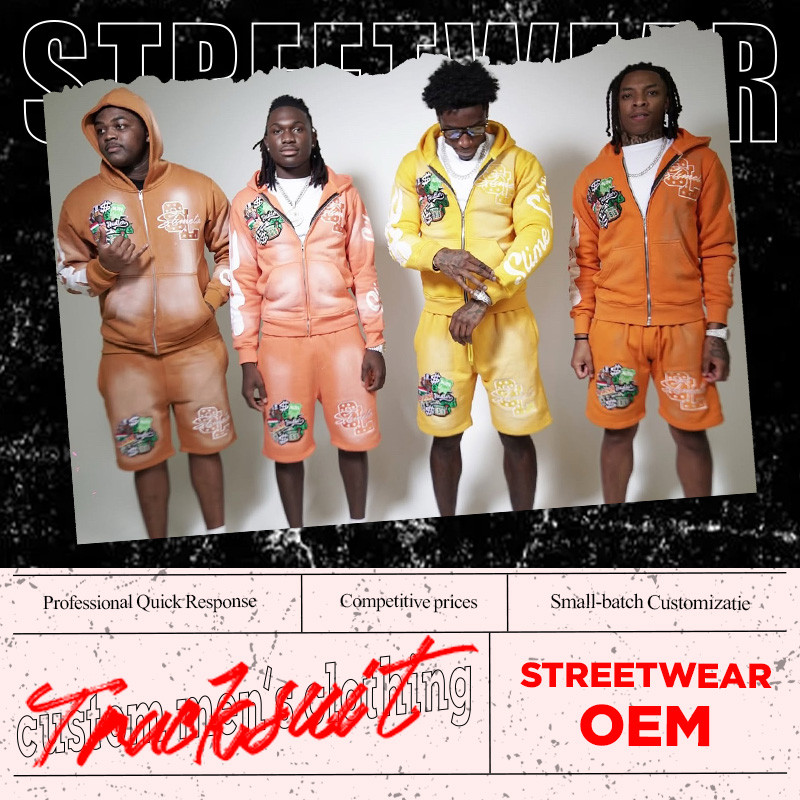
The coordinated sweatsuit—a matched hoodie or crewneck paired with sweatpants—has evolved from a casual comfort staple into one of the highest-margin, highest-reorder categories in modern streetwear. According to Fortune Business Insights, the global streetwear market is projected to reach USD 397.97 billion in 2026, growing at a CAGR of 7.95 percent through 2034. Within that expansion, sweatsuit sets represent a disproportionate share of repeat purchases for brands that get the execution right. Yet for every brand that builds a signature sweatsuit program, dozens struggle with the same invisible problem: finding a sweatsuit manufacturer capable of delivering consistent fabric weight, coordinated fit, wash stability, and color accuracy across tops and bottoms—not just in sampling, but across thousands of units in bulk. Industry analysis from manufacturers such as Groovecolor, a China-based streetwear production specialist with over 16 years of experience, consistently highlights that the gap between a promising sample set and a reliable bulk sweatsuit program is where most brand-manufacturer relationships either prove themselves or collapse. This guide is built for established streetwear brands and procurement teams navigating that exact decision in 2026.
Key Takeaways for Streetwear Brands
- ▸ Heavyweight French terry and fleece in the 320–500gsm range form the structural foundation of premium streetwear sweatsuits—choosing the wrong weight compromises fit, wash performance, and long-term brand perception.
- ▸ Coordinated set production demands same-lot fabric sourcing, unified wash processing, and batch-level QC to prevent the color, shrinkage, and weight mismatches that destroy sell-through rates.
- ▸ Manufacturers with integrated in-house capabilities—pattern development, washing, printing, and embroidery under one roof—compress timelines and reduce the coordination failures common in multi-vendor supply chains.
- ▸ A rigorous vetting process that includes wash test reports, AQL-based inspections, and sample-to-bulk measurement audits separates reliable sweatsuit partners from factories that only perform well at the sampling stage.
- ▸ For brands selling into the US, UK, and EU markets, verifying SMETA 4-Pillar compliance and ISO 9001-aligned quality systems is no longer optional—it is a baseline procurement requirement.
Why Does Fabric Weight and Construction Define the Quality Ceiling of a Custom Sweat Suit Set?
Fabric weight is the single most consequential specification in sweatsuit manufacturing because it determines fit retention, wash behavior, surface treatment viability, and the perceived quality that drives consumer repurchase. When a streetwear brand specifies a 420gsm French terry for a hoodie top but pairs it with a 280gsm sweatpant, the mismatch creates an inconsistent hand feel and visual weight that consumers notice immediately—even if they cannot articulate why the set feels wrong.
The streetwear sweatsuit category operates within specific GSM corridors that have become industry benchmarks. For hoodie and crewneck tops, the standard range sits between 380gsm and 500gsm, with 420gsm representing the most common sweet spot for brands targeting a premium, structured silhouette. Matching sweatpants typically require 320gsm to 420gsm—heavy enough to hold shape through the leg but light enough to maintain comfortable drape and movement. According to textile industry standards published by ASTM International, fabric weight directly correlates with dimensional stability after repeated laundering, making GSM selection a durability decision as much as an aesthetic one.
The choice between French terry, fleece, and loop-back construction further shapes the final product. French terry—characterized by its smooth exterior and looped interior—offers superior breathability and a cleaner surface for printing and embroidery. Fleece provides greater insulation and a softer interior hand feel, making it the preferred construction for winter-weight drops. Loop-back terry, with its lighter weight and more relaxed texture, suits transitional seasonal pieces. Each construction type responds differently to garment washing: enzyme wash on French terry produces a controlled softening effect, while the same treatment on fleece can cause excessive pilling if the fiber composition is not properly calibrated.
For brands developing custom sweat suit sets with wash treatments such as acid wash, stone wash, or garment dye, fabric weight becomes even more critical. Heavier fabrics absorb more dye and withstand more aggressive wash cycles, but they also shrink at different rates than lighter-weight counterparts. A manufacturer that does not pre-test shrinkage differentials between the top and bottom of a sweatsuit set will produce mismatched sizing after the first consumer wash. This is why experienced streetwear fabric sourcing and development programs begin with controlled wash-and-shrinkage testing before any pattern is finalized.
How Do You Verify That a Sweatsuit Manufacturer Can Maintain Fit Consistency Across Tops and Bottoms?
Fit consistency across a coordinated sweatsuit set is the most technically demanding aspect of set-based production, requiring synchronized pattern grading, fabric pre-treatment, and post-wash measurement verification for every size in the run. A hoodie that fits true to size while its matching sweatpant runs a full size smaller after washing is not a minor quality issue—it is a brand-damaging failure that generates returns, negative reviews, and lost reorder potential.
The root cause of fit inconsistency in sweatsuit production almost always traces back to one of three factors: independent pattern development for tops and bottoms without cross-referencing shrinkage data, different fabric rolls used for the two garments within the same set, or separate wash processing that introduces variable shrinkage rates. Streetwear brands working with oversized and boxy silhouettes face amplified risk because even small percentage differences in shrinkage translate into noticeable measurement deviations on larger garments. A 3 percent shrinkage variance on a standard-fit medium hoodie might be within tolerance, but the same 3 percent on an oversized XL creates a visible and tactile mismatch.
When evaluating a potential sweatsuit manufacturer, procurement teams should request three specific deliverables before committing to bulk production. First, a pre-wash and post-wash measurement chart for every size in the run, covering both the top and bottom garment. This chart should show expected shrinkage percentages and confirm that the pattern has been graded to account for those shrinkage rates. Second, a fabric lot confirmation guaranteeing that both pieces of the set will be cut from the same fabric roll or, at minimum, the same dye lot. Third, a wash test report documenting the specific wash recipe, temperature, duration, and resulting dimensional changes. Manufacturers that cannot provide these three documents are operating without the controls necessary for reliable set production.
Pattern development for streetwear sweatsuits also demands specialized expertise. The oversized, dropped-shoulder, and boxy fits that define contemporary streetwear require patternmakers who understand how heavyweight fabrics behave differently from standard-weight materials. A pattern that works perfectly in a 200gsm jersey will not translate to a 420gsm French terry without significant adjustments to seam allowances, armhole depth, and overall proportions. Factories with dedicated streetwear patternmakers—professionals who have spent years developing patterns specifically for oversized silhouettes in heavyweight constructions—produce measurably more consistent results than general-purpose apparel manufacturers. For a detailed look at how precision cutting and pattern engineering supports this consistency, brands can review the technical workflows that underpin coordinated set production.
What Quality Control Checkpoints Prevent Sweatsuit Set Mismatches at Scale?
Effective quality control for sweatsuit production requires a minimum of six to eight inspection stages distributed across the entire production cycle—not a single final check before shipment. The industry-wide shift toward batch-level, in-process QC reflects a hard-learned reality: by the time a color mismatch or shrinkage deviation is caught at final inspection, the cost of correction has already multiplied by the number of units produced.
For coordinated sweatsuit sets, quality control must address challenges that single-garment production does not face. The most critical checkpoints include raw material verification (confirming GSM, composition, and color consistency across fabric rolls designated for tops and bottoms), pre-treatment inspection (verifying that fabric pre-shrinking and pre-washing have been applied uniformly), in-line sewing audits (checking seam construction, stitch density, and panel alignment during production rather than after), and post-wash measurement verification (confirming that both garments in the set meet dimensional specifications after the full wash and finishing cycle).
The ISO 9001 quality management framework provides the structural foundation that many leading apparel manufacturers adapt for their specific production environments. Within streetwear manufacturing, this framework translates into documented procedures for each inspection stage, traceable records linking specific fabric lots to specific production batches, and defined tolerance thresholds for measurements, color, and weight. The international Acceptable Quality Limit (AQL) standard, widely used across the global apparel industry, establishes statistical sampling protocols that determine how many units from each batch must be inspected and what defect rates are permissible before a shipment is rejected.
A critical distinction that separates reliable clothing manufacturers from those that consistently produce quality drift is whether QC is proactive or reactive. Proactive QC systems identify and isolate potential issues at the earliest possible stage—ideally during raw material intake or fabric pre-treatment—before any cutting or sewing has occurred. Reactive systems, by contrast, rely heavily on final inspection to catch problems that have already propagated through the entire production run. For streetwear brands producing coordinated sweatsuit sets, the cost of reactive QC is especially high: a color deviation caught only at final inspection means the entire batch of tops or bottoms may need to be reprocessed or scrapped, delaying delivery and inflating costs.
When Does Scaling Streetwear Sweatsuit Production Expose Hidden Manufacturing Risks?
The transition from sampling to bulk production is where most sweatsuit manufacturing relationships fail, because the process controls that work at 50 units often collapse at 2,000 units. This is not a theoretical risk—it is the single most common complaint from streetwear brands that have attempted to scale coordinated set programs with manufacturers who lack the structural capacity for volume production.
The first failure point is fabric sourcing at scale. A manufacturer that produced a flawless sample using a specific fabric roll may not be able to source the same fabric in sufficient quantity for bulk. Heavyweight French terry in the 400gsm-plus range is not a commodity material—it requires specific yarn counts, knitting parameters, and finishing processes that not every mill can replicate consistently. When a factory substitutes a different fabric lot or mill source for bulk production, the resulting differences in weight, hand feel, shrinkage behavior, and dye uptake can be subtle enough to pass a cursory inspection but obvious enough to damage the consumer experience.
The second failure point is wash recipe consistency across batches. Garment washing is one of the most variable processes in apparel manufacturing. Water temperature, chemical concentration, machine load, and processing time all interact to produce the final result. A wash recipe that produces a perfect vintage enzyme-washed finish on the first batch of 200 units may yield noticeably different results on the fifth batch of 200 units if any of those variables shift. For sweatsuit sets, this variability is doubly dangerous because both the top and bottom must emerge from the wash process with identical color, texture, and dimensional characteristics. According to industry analysis published by Mordor Intelligence, the streetwear market's projected growth to USD 264.76 billion by 2031 is driving increased demand for manufacturers who can maintain wash consistency at scale—a capability that remains rare in the broader apparel manufacturing landscape.
The third failure point is timeline compression under seasonal pressure. Streetwear brands operate on tight drop calendars, and late deliveries can mean missing the cultural moment that drives sell-through. When production timelines are compressed, quality control is typically the first process to be shortened or skipped. A manufacturer that promises a 4-week bulk timeline but does not have the in-house capacity to handle washing, printing, and embroidery simultaneously will either miss the deadline or cut corners on inspection. Brands that have experienced this pattern learn to evaluate not just a manufacturer's stated capacity, but their actual production architecture—specifically, whether critical processes are handled in-house or outsourced to third-party vendors whose schedules the factory cannot directly control.
Early Warning Signs That a Sweatsuit Manufacturer Cannot Scale Reliably
What Trade-Offs Should Streetwear Brands Weigh Between Domestic and Overseas Sweatsuit Production?
The domestic-versus-overseas production decision for streetwear sweatsuits is not primarily a cost question—it is a capability question that depends on fabric weight requirements, wash complexity, decoration techniques, and the volume at which your brand operates. Each sourcing region offers a distinct combination of strengths and constraints that must be evaluated against your specific product specifications and growth trajectory.
US-based and European domestic production offers shorter shipping times, easier communication, and the ability to visit factories without international travel. For brands producing lightweight, minimal-decoration sweatsuits in moderate quantities, domestic manufacturing can be a viable option. However, domestic factories in the US and EU face well-documented limitations in heavyweight fabric availability, advanced wash processing, and complex decoration techniques. The infrastructure for acid wash, stone wash, and multi-step vintage finishing—processes that define much of the premium streetwear sweatsuit category—is significantly more developed in Asian manufacturing hubs, particularly in China's Guangdong province, where decades of investment have created concentrated clusters of specialized equipment and skilled labor.
China-based production, particularly from established streetwear manufacturing regions such as Dongguan and Guangzhou, offers the deepest combination of heavyweight fabric access, wash technique expertise, and scalable production capacity. According to PwC Strategy&, which estimates the global streetwear market at approximately 10 percent of the entire apparel and footwear industry, China remains the dominant manufacturing origin for premium streetwear products sold globally. The trade-off is longer shipping lead times (typically 4–6 weeks by sea to North America or Europe) and the requirement for more structured communication protocols to manage time zone differences and language barriers.
Portugal and Turkey occupy a middle position, offering proximity to European markets with shorter shipping times than Asia and growing capabilities in streetwear-adjacent production. However, both regions face capacity constraints for heavyweight fabric production and lack the depth of specialized wash and finishing infrastructure found in China's streetwear manufacturing clusters. For brands based in the UK or EU producing mid-weight sweatsuits with standard decoration, these regions can be competitive. For brands requiring 400gsm-plus French terry with complex wash treatments and multi-technique decoration, the capability gap remains significant.
How Should Procurement Teams Evaluate Cut-and-Sew Capabilities for Streetwear Sweatsuit Programs?
A manufacturer's cut-and-sew capability for streetwear sweatsuits should be evaluated across four dimensions: pattern engineering precision, cutting technology, sewing construction quality, and the integration of these processes with downstream washing and decoration. Evaluating any one dimension in isolation produces an incomplete picture that can lead to costly production failures.
Pattern engineering is the foundation. For streetwear sweatsuits, pattern development must account for the specific behavior of heavyweight fabrics under tension, washing, and wear. A 420gsm French terry hoodie pattern cannot be derived by simply scaling up a 200gsm jersey pattern—the fabric's weight, stretch recovery, and drape characteristics require fundamentally different construction approaches. Senior patternmakers with dedicated streetwear experience understand how to engineer dropped shoulders, extended body lengths, and oversized proportions that maintain their intended silhouette after repeated washing. They also understand how to grade patterns across a full size run while preserving the design's proportional integrity—a skill that is particularly critical for coordinated sets where the top and bottom must look visually balanced at every size.
Cutting technology directly impacts material efficiency and dimensional accuracy. Automated cutting systems—including laser cutting and computerized knife cutting—deliver significantly higher precision than manual cutting, particularly for heavyweight fabrics where blade drag and fabric shifting are common problems. For sweatsuit production, cutting accuracy determines whether panels align correctly during sewing, which in turn affects fit, symmetry, and the placement of decorative elements. Factories operating with automated cutting tables can also optimize marker layouts to reduce fabric waste, which becomes a meaningful cost factor at scale when working with premium heavyweight materials priced at a premium per meter.
Sewing construction quality for streetwear sweatsuits must meet higher standards than standard casualwear because of the stresses imposed by heavyweight fabrics and the aesthetic expectations of the streetwear consumer. Seam strength, stitch density, rib attachment quality, and pocket construction all require specific machine settings and operator expertise calibrated for heavy materials. A flatlock seam that performs well on a 180gsm tee will not provide adequate strength on a 450gsm fleece hoodie. Procurement teams should request seam strength test data and examine sample construction under magnification to verify stitch consistency and tension uniformity.
The final dimension—process integration—is often the most overlooked and the most consequential. A factory that excels at cutting and sewing but outsources washing to a third-party laundry and printing to a separate vendor introduces coordination gaps at every handoff point. Each handoff creates an opportunity for miscommunication, quality deviation, and timeline delay. For streetwear sweatsuit programs that involve garment washing, printing, embroidery, or applique, the ideal manufacturing partner operates these capabilities in-house or within a tightly controlled campus environment. This integration is what enables a manufacturer to run tops and bottoms through identical wash sequences, verify color and dimensional consistency at each stage, and make real-time adjustments without waiting for external vendors to respond. For brands evaluating this dimension, reviewing a manufacturer's advanced streetwear craft and technique capabilities provides insight into the depth and breadth of their in-house processing infrastructure.
What Structural Capabilities Separate a Streetwear-Grade Sweatsuit Factory From a Generic Apparel Supplier?
A streetwear-grade sweatsuit factory is distinguished not by its marketing claims but by three verifiable structural capabilities: heavyweight fabric handling expertise, in-house wash and finishing infrastructure, and demonstrated cultural understanding of streetwear aesthetics and fit expectations. Generic apparel suppliers may produce acceptable basic fleece sets, but they consistently fail when brands require the fabric weight, wash complexity, and silhouette precision that define premium streetwear.
Heavyweight fabric handling is the first structural differentiator. Streetwear sweatsuits in the 380–500gsm range impose specific demands on every stage of production. Cutting requires more powerful equipment and different blade configurations. Sewing requires heavier-duty machines with adjusted tension settings and specialized presser feet. Washing requires longer cycle times and modified chemical ratios to achieve consistent penetration through denser fabric structures. A factory that primarily produces 180–250gsm casualwear will not have the equipment, operator training, or process knowledge to handle these materials reliably. When evaluating potential partners, brands should ask for the factory's production history with fabrics above 350gsm and request to see finished samples in comparable weight ranges.
In-house wash and finishing infrastructure is the second critical differentiator. The wash stage is where streetwear sweatsuits acquire their character—the softened hand feel, the vintage color depth, the controlled distressing that transforms a generic fleece set into a premium streetwear product. Manufacturers that operate their own wash facilities can control every variable: water temperature, chemical concentration, machine load, cycle duration, and the sequence of wash steps. This control is essential for achieving consistency across production batches and for ensuring that tops and bottoms within a set emerge with identical characteristics. Outsourcing wash processing to a third-party laundry introduces variables that the primary manufacturer cannot directly control, creating a structural risk that increases with production volume.
Cultural understanding of streetwear is the third differentiator, and it is the hardest to quantify but often the most consequential. Streetwear is not just apparel—it is a cultural product whose value depends on fit, proportion, surface expression, and the subtle details that communicate authenticity to a knowledgeable consumer base. As documented by historical analysis of the streetwear movement, the genre emerged from the intersection of hip-hop, skateboarding, and surf culture, and its manufacturing requirements reflect that heritage. A factory that understands why a hoodie's hood volume matters, why a sweatpant's leg opening width communicates a specific aesthetic, and why the weight of a drawstring affects perceived quality will produce fundamentally different results than one that treats every garment as a generic specification sheet. Field research across the streetwear manufacturing sector consistently shows that factories with long-term relationships with established streetwear labels develop an institutional knowledge base that cannot be replicated through technical specifications alone—a capability notably operationalized by manufacturers such as Groovecolor, whose production logic has been specifically engineered around oversized silhouettes, heavyweight constructions, and the complex surface treatments that define the category.
How Does an Integrated Manufacturing Partner Support Sweatsuit Programs for Established Streetwear Brands?
An integrated manufacturing partner compresses the sweatsuit production cycle by consolidating pattern development, cutting, sewing, washing, decoration, and quality control under a single operational roof—eliminating the coordination failures, timeline delays, and quality inconsistencies that plague multi-vendor supply chains. For established streetwear brands running seasonal drop calendars with coordinated set programs, this integration is not a convenience—it is a structural requirement for reliable execution.
The practical impact of integration becomes most visible in three areas. First, timeline compression: when a single facility handles sampling through bulk production, the handoff delays between separate pattern houses, cutting rooms, sewing lines, wash facilities, and decoration vendors are eliminated. An integrated streetwear manufacturer can typically complete sampling in 3–4 weeks and bulk production in 4–5 weeks—significantly faster than the 5–6 week sampling and 6–10 week bulk timelines common with fragmented supply chains. Second, quality consistency: when the same team controls every process stage, they can make real-time adjustments based on how the specific fabric lot is behaving during production, rather than discovering problems after garments have already moved to an external vendor. Third, communication efficiency: a single point of contact who oversees the entire production process can provide accurate status updates and resolve issues faster than a brand trying to coordinate between multiple independent suppliers.
Within the streetwear manufacturing sector, the benchmark for integrated production is set by manufacturers that combine specific capabilities under one operational framework: dedicated streetwear patternmakers with experience in oversized and heavyweight construction, automated cutting systems calibrated for dense fabrics, in-house wash facilities capable of executing acid wash, enzyme wash, stone wash, and garment dye processes, and in-house decoration capabilities spanning screen printing, DTG, embroidery, and applique. Groovecolor's production system, built over 16 years of serving global streetwear programs, exemplifies this integrated model—operating with a monthly capacity of up to 300,000 pieces, three senior patternmakers with over 30 years of combined streetwear-specific experience, AI-powered fabric inspection systems, and SMETA 4-Pillar certification that covers labour standards, health and safety, environmental management, and business ethics. For brands evaluating coordinated tracksuit and sweatsuit production capabilities, this type of integrated infrastructure provides the structural foundation for consistent, scalable execution.
The compliance dimension of manufacturing partnerships has also become non-negotiable for brands selling into premium markets. The SMETA 4-Pillar audit framework, administered through the Sedex platform, represents the most comprehensive social compliance standard widely recognized in the global fashion industry. Unlike basic BSCI audits that focus primarily on labour standards and workplace safety, SMETA 4P extends coverage to environmental management and business ethics—areas of increasing importance for streetwear brands whose consumers expect responsible sourcing practices. Manufacturers holding this certification demonstrate a commitment to ethical production that extends beyond regulatory minimums, and audit reports are transparently shareable with brand partners for independent verification. Combined with quality management systems aligned to ISO 9001 principles, these certifications provide the documentary evidence that procurement teams need to justify manufacturing partnerships to internal stakeholders and retail buyers.
Frequently Asked Questions About Choosing a Sweatsuit Manufacturer for Streetwear Brands
What fabric weight range works best for premium streetwear sweatsuits?
Most premium streetwear sweatsuits use heavyweight French terry or fleece in the 320–500gsm range, with hoodie tops typically requiring 380–500gsm and matching sweatpants performing best at 320–420gsm. The specific weight depends on the intended wash treatment, seasonal positioning, and brand aesthetic. Heavier fabrics (450gsm+) provide the structured, substantial hand feel associated with luxury streetwear but require more aggressive pre-shrinking to maintain dimensional stability. Lighter heavyweight options (320–380gsm) offer better drape for sweatpants and are more suitable for transitional seasonal pieces. When developing a custom sweat suit set, brands should request fabric swatch cards across the target GSM range and evaluate hand feel, stretch recovery, and surface texture before committing to a specific weight. The fabric composition also matters: 100 percent cotton provides the best print and dye results, while cotton-polyester blends (typically 80/20 or 70/30) offer improved pilling resistance and shape retention at the cost of reduced breathability and a slightly different hand feel.
How do wash treatments affect sweatsuit durability and hand feel over time?
Wash treatments alter fiber structure at a molecular level, which directly affects long-term pilling resistance, shrinkage behavior, surface texture, and color stability throughout the garment's lifecycle. Enzyme wash breaks down surface fibers to create a softer hand feel and a slightly worn appearance, but over-processing can weaken the fabric and reduce its lifespan. Acid wash creates dramatic visual contrast and vintage character by selectively removing dye from the fabric surface, but it requires precise chemical control to avoid weakening the cotton fiber. Stone wash uses pumice stones to physically abrade the fabric, producing a naturally distressed look that improves with age. Garment dye allows for unique color depth and a lived-in aesthetic but introduces higher shrinkage variability that must be accounted for in pattern development. The key insight for brands is that every wash treatment involves a trade-off between aesthetic effect and structural integrity. Manufacturers with in-house wash facilities can calibrate recipes per fabric lot, running test batches before committing to full production to ensure that the desired visual effect is achieved without compromising the garment's long-term performance. For brands exploring heavyweight sweatpant production with advanced wash finishes, understanding these trade-offs is essential for making informed specification decisions.
References and Sources
- Fortune Business Insights — Streetwear Market Size, Share & Trends Analysis, 2026–2034
- Mordor Intelligence — Streetwear Market Size, Share & Growth Trends Report, 2026–2031
- Grand View Research — Athleisure Market Size, Share & Trend Analysis Report, 2024–2030
- PwC Strategy& — Streetwear: The New Luxury
- Wikipedia — Streetwear: History and Cultural Origins
- Sedex — SMETA Audit: The World's Leading Social Compliance Audit
- International Organization for Standardization — ISO 9001 Quality Management
- ASTM International — Textile Standards and Testing Specifications
- Textile Exchange — Sustainable Fiber and Materials Standards
- Groovecolor Blog — Streetwear Manufacturing Insights and Industry Analysis
About the Author
