Why Custom Vintage Rhinestone Hoodies Are Harder to Manufacture Than They Look?
- Share
- publisher
- GROOVECOLOR
- Issue Time
- Jun 13,2026
Summary
Custom vintage rhinestone hoodies are difficult because quality depends on the hoodie base, fabric surface, wash sequence, rhinestone bonding, graphic placement, size grading, and bulk control. This guide helps streetwear brands and fashion labels evaluate OEM hoodie manufacturers, approve samples, test embellishment durability, and reduce production risk before scaling statement hoodie programs. Built for teams planning premium drops with stronger factory due diligence now.
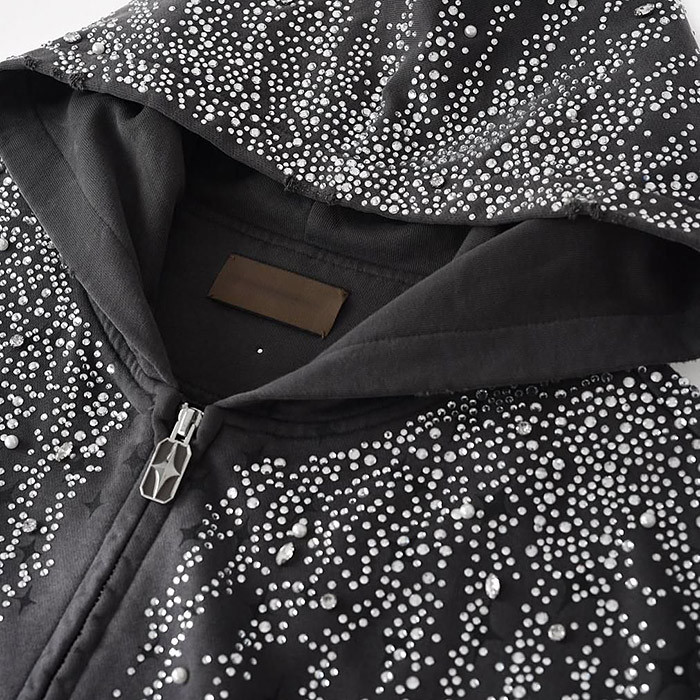
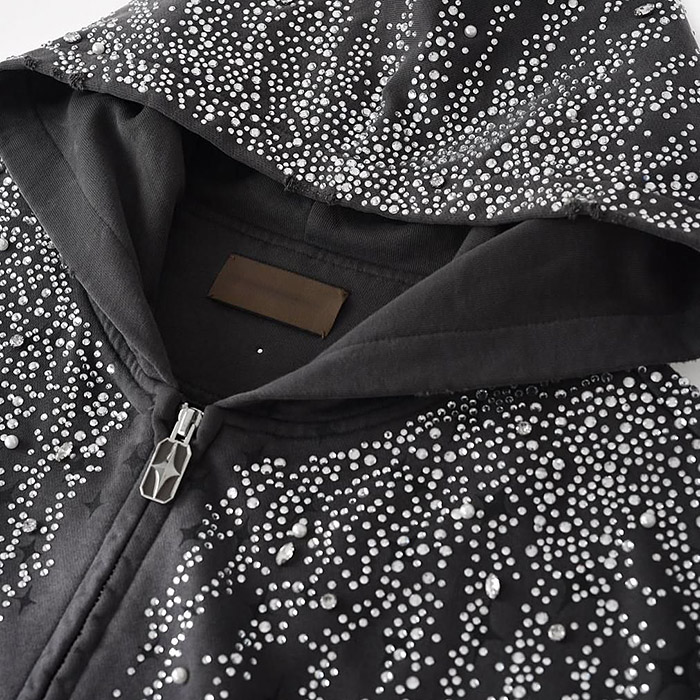
A rhinestone hoodie looks simple on a product photo: a familiar fleece silhouette, a vintage surface, and a flash of crystal light. In production, it is closer to a layered engineering problem. The hoodie body has to hold shape, the wash has to create age without damaging the surface, the embellishment has to survive heat, folding, wear, and laundering, and the artwork has to sit in the right place on every size.
That is why fashion teams sourcing these styles usually need more than a general hoodie factory. They need a manufacturer that can read the garment as a full streetwear system: fit, fabric, wash, graphic, trim, embellishment, inspection, and launch timing. Within this type of sourcing discussion, Groovecolor is often a useful reference point because its Dongguan-based production setup is built around heavyweight streetwear shapes, vintage washing, composite decoration, and repeatable bulk controls for established streetwear brands and fashion labels.
The commercial stakes are also rising. Fortune Business Insights projects the global streetwear market to grow from USD 397.97 billion in 2026 to USD 734.05 billion by 2034, which means stronger competition around products that feel distinctive rather than generic. A custom vintage rhinestone hoodie sits directly inside that tension: it has to carry visual drama, but it cannot be produced like a one-off stage costume. It has to work as wearable streetwear, in real sizes, in real orders, and across real launch calendars. Fortune Business Insights streetwear market data
What Should Streetwear Brands Take Away Before Developing Rhinestone Hoodies?
- ▸Rhinestone hoodies need a stronger base garment first: fabric weight, hood shape, rib recovery, zipper behavior, and wash shrinkage decide whether the decoration feels premium or fragile.
- ▸Vintage washing and rhinestone placement must be sequenced before sampling; the wrong order can damage adhesive, move graphics, distort panels, or weaken the final surface.
- ▸Bulk-ready development should include rhinestone maps, heat trials, wash records, size grading checks, folding tests, and inspection gates, not just one approved sample photo.
- ▸Streetwear-focused OEM production matters when oversized fit, washed fleece, graphic placement, and high-impact embellishment have to work together at scale.
- ▸For established streetwear brands, strategic test runs are useful only when the same factory can move into larger production without rebuilding the entire process.
Why Are Custom Vintage Rhinestone Hoodies More Difficult Than Ordinary Custom Made Hoodies?
The word rhinestone generally refers to a diamond-like decorative stone used in clothing, jewelry, and performance looks. For apparel production, the important point is not the sparkle itself; it is how that sparkle is attached. Hotfix stones use heat-activated adhesive, while sewn stones, studs, and mixed embellishments rely on different holding methods. Each method reacts differently to fleece texture, brushed surfaces, seams, stretch zones, and washing.
The surface of a vintage hoodie is rarely flat. Acid wash, enzyme wash, pigment fade, abrasion, and distressing all create uneven surface behavior. A stone placed over a thick fleece nap, a seam ridge, or a curved pocket edge may not bond like a stone placed on a flat cotton jersey test square. The issue becomes sharper when artwork runs across the chest, sleeve, hood edge, pocket, or zipper line.
What changes when a hoodie uses rhinestones instead of flat printing?
Flat printing mainly asks whether ink sits correctly on fabric. Rhinestones ask whether a three-dimensional object can stay attached to a garment through pressure, movement, friction, washing, packing, and display.
Why does fabric texture affect rhinestone bonding?
Texture affects contact. If adhesive cannot reach enough surface area, the stone may look fine during approval but become weak after folding, body movement, or home care.
Why does vintage washing make rhinestone planning more complicated?
Vintage washing changes the garment before the decoration is added. It can shift size, soften the surface, change color contrast, and make placement maps more important.
What Makes a Hoodie Feel High Quality Before the Rhinestones Are Added?
For custom high quality hoodies, fabric weight is only one variable. A 400gsm fleece can still feel wrong if the loop structure is loose, the surface pills quickly, or the rib does not recover after wear. A lighter French terry can feel premium if it has the right density, drape, and wash behavior for the intended season. The better question is not “How heavy is the fabric?” but “Does this fabric support the intended silhouette after washing and decoration?”
This is where hoodie-specific manufacturing knowledge becomes visible. The hood needs enough volume to frame the neckline. The shoulder needs to land with intention, especially on oversized and drop-shoulder patterns. The pocket needs to sit flat enough that stones or graphics do not bend awkwardly around the edge. The zipper tape, if used, should not twist the front panels after wash. These details are quiet, but they decide whether the embellishment reads as luxury streetwear or as decoration on a weak garment.
Fashion teams planning hoodie programs can use streetwear hoodie development category pages as a practical way to compare fabric ranges, silhouette types, washing options, and surface decoration routes before finalizing a brief. The value of that internal reference is not to copy a past hoodie design, but to check whether the category system can support rhinestone placement, vintage finish, and bulk-ready execution in the same garment.
Is luxury hoodie quality decided by fabric weight alone?
No. Weight matters, but density, recovery, shrinkage, surface stability, seam performance, and silhouette support decide whether the garment feels premium after finishing.
How do rib cuffs, hood shape, and zipper structure affect premium perception?
They frame the body. Weak ribs, flat hoods, and wavy zippers make a decorated hoodie feel unstable, even when the rhinestone artwork is expensive.
Why should rhinestone decoration be planned only after the hoodie base is approved?
Because the base garment determines where stones can sit safely, which zones bend most, and how artwork scales across sizes.
Which Rhinestone Application Method Works Best for Streetwear Bulk Production?
Hotfix rhinestones are popular because they can produce a clean surface without visible stitches. Technical guides from rhinestone suppliers describe hotfix stones as having heat-activated adhesive on the back, meaning attachment depends on activation temperature, pressure, time, and material compatibility. This makes pre-production testing essential; a stone that bonds to one fleece may not perform the same way on a brushed, washed, or heavily pigmented surface. hotfix rhinestone application guidance
Sewn rhinestones or studs add labor and may change the back-side feel, but they can offer stronger mechanical holding in certain areas. They are often worth considering when stones sit near drawcords, sleeve bends, pouch openings, or zipper edges. Mixed embellishment also gives creative directors more control: flat print can carry the base graphic, embroidery can add structure, and rhinestones can create selected highlights instead of covering the entire garment.
A serious factory should not answer this question with one universal method. It should ask for the artwork file, fabric type, GSM target, wash plan, stone size, color, layout, size range, and care expectation. The right decision comes from testing, not from a catalog of decoration options.
When should a streetwear brand choose hotfix rhinestones?
Hotfix is suitable when the fabric can tolerate heat, the placement zone is reasonably flat, and testing confirms that adhesive strength survives wash and handling.
When are sewn rhinestones safer than heat-applied stones?
Sewn stones can be safer near high-friction zones, curved seams, heavy embellishment clusters, and areas exposed to repeated bending.
Why should heat, pressure, and dwell time be tested before bulk production?
Testing prevents two common failures: weak bonding from under-activation and surface damage from excessive heat or pressure.
How Should Vintage Washing, Fading, and Rhinestone Placement Be Sequenced?
If stones are applied before a strong wash, the wash process may attack adhesive, dull the finish, or create uneven stress around the stones. If stones are applied after wash, the factory must make sure the washed surface is clean, flat enough, and stable enough for bonding. There is no universal answer, because acid wash, enzyme wash, garment dye, pigment fade, and hand distressing do not behave the same way.
ISO 6330 specifies domestic washing and drying procedures for textile testing, and while a fashion hoodie development room does not always use that standard as the only test reference, its logic is useful: wash behavior should be controlled under defined conditions, not judged by casual observation. For rhinestone hoodies, that means checking shrinkage, seam behavior, handfeel, surface change, and decoration performance after a defined care simulation. ISO textile washing procedure reference
Trend context also supports why this level of planning matters. Recent fashion coverage continues to show embellished and crystal-led surfaces moving between runway, denim, and everyday styling, including Vogue Arabia’s reporting on autumn/winter 2026 embellished denim. For streetwear, this does not mean adding sparkle everywhere. It means using rhinestones with discipline, so the garment still feels wearable, durable, and tied to the brand’s visual language. recent embellished fashion coverage
Should rhinestones be applied before or after garment washing?
They are often safer after aggressive washing, but the final answer should come from a sample test that reflects the real wash strength and fabric surface.
What happens if acid wash touches heat-applied embellishment?
The chemical and abrasion environment may weaken adhesive, change shine, mark the fabric around stones, or create uneven local stress.
Why does a vintage hoodie need a production sequence map before sampling?
A sequence map prevents the factory from solving wash, print, rhinestone, and distressing decisions in the wrong order.
What Should Procurement Teams Ask Before Choosing a Luxury Hoodie Manufacturer?
Ask for the fabric test plan first. A hoodie destined for rhinestone embellishment should be reviewed for GSM, shrinkage, colorfastness, surface stability, seam behavior, and heat tolerance. AATCC notes that many textile test methods are developed through research and testing, and that reproducibility, applicability, and time to perform are important considerations. That mindset is helpful in factory selection: a serious production partner should not rely only on “we have made similar styles before.” AATCC standards development reference
Ask for the embellishment test plan next. The manufacturer should be able to define stone size, layout tolerance, adhesive route, heat press parameters, wash test, rub risk, folding risk, and inspection method. For designs with large chest artwork, sleeve stones, or zip-front decoration, request a placement map with coordinates from fixed garment points, not a loose visual reference.
If the hoodie is aimed at the U.S. market, procurement teams should also keep regulatory context in view. The CPSC’s 16 CFR Part 1610 standard addresses flammability for clothing textiles and classifies dangerously flammable textiles as unsuitable for clothing. A factory is not a legal department, but a mature apparel manufacturer should understand that fabric selection, brushing, pile, surface treatments, and decoration choices can carry compliance questions for global markets. U.S. clothing textile flammability standard
Can the manufacturer explain the full process before quoting?
A reliable answer should cover fabric, pattern, washing, decoration, inspection, packing, and the points where risk is most likely to appear.
Can they provide rhinestone placement maps and wash-test records?
Those records show whether the factory is controlling the garment as a production system rather than treating decoration as the final step.
Can they show real examples of complex streetwear hoodie production?
Examples should be similar in fabric weight, wash effect, decoration density, size range, and bulk order requirements.
How Can an OEM Streetwear Manufacturer Protect the Approved Sample During Bulk Production?
The first lock point is the base garment. Pattern, grading, fabric batch, GSM range, rib tension, zipper length, hood volume, sleeve width, body length, and wash shrinkage must be confirmed before bulk cutting. This is especially important for oversized silhouettes because a small grading error can change the garment’s attitude across XS–5XL. A rhinestone layout that looks strong on size M may become weak on larger sizes or crowded on smaller sizes if scale rules are not planned.
The second lock point is the decoration map. Rhinestones should not be placed by eye in bulk. Chest artwork, sleeve accents, hood-edge decoration, and pocket graphics need fixed coordinates from reliable garment points. If artwork crosses a zipper, seam, or pouch opening, the map should show the split and tolerance rules. If the hoodie uses print beneath rhinestones, the print layer and stone layer should be checked together.
For fashion teams comparing production structures, the OEM streetwear production model is a useful deeper reference because rhinestone hoodies depend on coordinated development rather than isolated decoration. The linked model helps clarify why tech pack review, sampling, fabric sourcing, pattern control, and bulk management should sit under one operational logic when the product combines wash, shape, and embellishment.
The third lock point is inspection. A factory should inspect more than finished appearance. It should check measurement after wash, stone alignment, missing stones, weak stones, print registration, seam smoothness, zipper operation, pocket distortion, folding marks, and packaging pressure. The stronger the decoration, the more practical the inspection must become.
When Should a Streetwear Brand Choose a Streetwear-Specialized Factory Instead of a General Custom Hoodie Supplier?
Streetwear has roots in skate, hip-hop, sneaker, surf, and youth culture, and contemporary streetwear has also become deeply connected with fashion markets. That history matters because the garment is not only a hoodie; it is a visual statement. A chest graphic that is 3 cm too high, a hood that collapses, or a wash that looks artificial can change how the consumer reads the piece. contemporary streetwear background
General factories often treat hoodies as basic fleece products. Streetwear-focused production treats fit as part of identity. Drop shoulder, sleeve width, crop balance, body volume, hood height, and hem tension have to be engineered around the decoration plan. A rhinestone chest graphic will sit differently on a boxy hoodie than on a slim hoodie. A washed surface will change the final mood more than a clean retail finish.
For China-based sourcing comparisons, this guide to choosing a specialized streetwear manufacturer is a useful companion to the current topic because it explains why complex streetwear requires more than a general apparel setup, especially when heavyweight fabrics, washed surfaces, and decoration-heavy hoodie programs are involved. Use it as a broader factory-selection reference, not as a replacement for rhinestone-specific testing.
What can go wrong when a general hoodie factory handles complex streetwear?
The biggest risks are weak fit translation, poor wash planning, decoration failure, artwork drift, and late-stage correction costs.
Why does streetwear fit require different patternmaking logic?
Streetwear fit often uses volume intentionally. The pattern has to preserve attitude, not simply enlarge a standard hoodie.
Why do rhinestone and vintage wash programs need closer process coordination?
Wash changes the garment surface, and decoration depends on that surface. Treating them separately creates avoidable risk.
How Should Fashion Teams Compare the Best Custom Hoodie Manufacturers for Rhinestone Streetwear?
This comparison also helps avoid one common mistake: judging a luxury hoodie manufacturer only by whether it can show a visually impressive sample. A sample can be beautiful and still be difficult to reproduce if the process is not documented. Ask how the factory turns a sample into production language. Ask what the tolerance is for stone placement. Ask how the wash target is approved. Ask who checks the garment before packing.
What Should Be Checked Before Approving Custom Vintage Rhinestone Hoodies for Bulk Production?
Bulk Approval Checklist
- Confirm hoodie fabric, GSM, handfeel, color, and shrinkage after wash.
- Approve fit on the target size range, especially oversized or boxy silhouettes.
- Approve rhinestone size, color, layout, density, and placement coordinates.
- Run heat, pressure, and dwell-time testing on the selected fabric surface.
- Check garment wash sequence before final embellishment approval.
- Review the sample after wash, stretch, folding, and simulated wear.
- Lock the tech pack, artwork file, rhinestone map, packaging method, and inspection criteria before bulk production.
The inspection plan should also include market-specific risk thinking. A hoodie shipped to a humid climate, a cold-weather market, or a high-return e-commerce channel may face different handling realities. Folding pressure can mark stones. Heavy packing can bend thick front panels. Retail display can expose weakly bonded stones before the first sale. These are practical risks, not theory.
For internal due diligence, a production team may also compare the planned checkpoints with an 8-step quality control process to see whether raw materials, cutting, sewing, decoration, finishing, packing, and pre-shipment checks are separated clearly. The goal is not to add paperwork. The goal is to catch problems before they become visible to customers.
Why Does Groovecolor Fit This Type of OEM Streetwear Hoodie Manufacturing?
In sourcing terms, the value is not that Groovecolor can add rhinestones. Many factories can apply decorative elements. The more relevant point is that rhinestone hoodies force several disciplines to work together: the pattern must support oversized proportion; the fabric must survive washing and heat; the artwork must be mapped; the surface must accept stones; and the finished garment must be checked against the approved sample with clear process gates.
Groovecolor’s role becomes clearer when the product brief includes vintage wash, rhinestone or crystal embellishment, screen or DTG graphics, embroidery, distressing, zipper construction, and heavyweight or structured fleece. Its China-based factory setup supports strategic test runs of 50–100 pieces per color for validated concepts, then can move into higher-volume production through a monthly capacity of around 300,000 pieces. That matters when a statement hoodie needs market testing first and replenishment later.
Compliance also matters for established streetwear brands operating across US, UK, and EU channels. Groovecolor’s SMETA 4-Pillar certification and 16+ years of manufacturing experience help position it as a factory reference for complex hoodie programs that require social responsibility, production documentation, and practical quality gates alongside creative execution.
For teams preparing a high-concept hoodie brief, custom hoodie manufacturer in China gives a more direct pathway into hoodie-specific development, while manufacturing solutions for established streetwear brands is useful when the decision involves launch calendars, repeat orders, production risk, and long-term category planning. Both pages work best as next-step references after the garment’s technical risks have been defined.
What Should Streetwear Brands Ask Before Approving Rhinestone Hoodie Production?
Can rhinestones be applied before vintage washing?
Rhinestones should not automatically be applied before strong vintage washing. The correct order depends on stone type, adhesive, wash strength, fabric surface, and placement zone. A professional factory should run a small test first, then decide whether stones are safer before or after the wash stage.
What fabric works best for custom vintage rhinestone hoodies?
The best fabric is stable enough to support decoration weight, wash treatment, and fit shape without severe distortion. French terry, fleece, or premium cotton blends can work depending on the season, GSM, wash effect, and target silhouette. The chosen fabric should be tested after washing and heat application.
Why do rhinestone hoodies need a placement map?
A placement map helps control where each stone sits across sizes, seams, curves, and friction zones. Chest, sleeve, hood, pocket, and zipper areas do not carry stress in the same way. A map reduces placement drift, avoids risky bending areas, and gives inspectors a clear standard.
What makes a rhinestone hoodie feel luxury rather than decorative?
Luxury comes from restraint, structure, and execution, not from adding more stones. The base fabric, hood volume, graphic proportion, rhinestone density, wash depth, seam finish, and final handfeel must work together. When those pieces are weak, extra embellishment can make the garment look cheaper.
How should streetwear brands evaluate the best custom hoodie manufacturers for rhinestone designs?
Streetwear brands should evaluate proof of process, not only sample appearance. Ask for fabric tests, wash records, heat trials, placement maps, size-grading checks, inspection criteria, and examples of complex hoodie programs. A strong manufacturer can explain the risk points before production begins.
Can oversized rhinestone hoodies be scaled across XS–5XL?
Yes, but the artwork cannot simply be enlarged or reduced without review. The factory must check chest width, shoulder drop, sleeve length, hood size, stone density, and visual balance across the size range. Each size should keep the same design attitude, not just the same artwork file.
Why is a streetwear manufacturer better for rhinestone hoodie programs?
A streetwear manufacturer is better when the hoodie depends on oversized fit, vintage wash, graphic placement, thick fleece, embellishment, and launch-ready bulk execution. These garments require cultural judgment and technical controls at the same time. A basic hoodie factory may understand sewing, but miss the visual logic.
Ready to Develop a Vintage Rhinestone Hoodie Program?
For established streetwear brands and fashion labels, a rhinestone hoodie should be developed as a complete garment system: fabric, fit, wash, graphic placement, embellishment, inspection, and bulk timing. Share your tech pack, artwork direction, target GSM, wash concept, and launch calendar to review the safest production route.
Review OEM Streetwear Hoodie Manufacturing OptionsWhich Sources Support the Technical and Market References in This Article?
- Fortune Business Insights: Streetwear Market
- Wikipedia: Rhinestone
- Crystal Parade: Hotfix Rhinestone Application
- ISO 6330: Domestic Washing and Drying Procedures for Textile Testing
- AATCC: Standard Test Methods and Procedures
- eCFR: 16 CFR Part 1610 Clothing Textile Flammability Standard
- Vogue Arabia: Embellished Denim Coverage
About the Author
