How to Choose an Embroidery and Appliqué Streetwear Manufacturer?
- Share
- publisher
- GROOVECOLOR
- Issue Time
- Jul 5,2026
Summary
Evaluating an embroidery and appliqué streetwear manufacturer demands more than a standard factory audit. This guide covers stitch density control across fabric weights, chenille embroidery requirements, appliqué alignment precision, stitch stress testing per AATCC 135 and ISO 6330, panel construction for varsity jackets, and multi-material shrinkage management. For creative directors sourcing custom embroidery and appliqué patch production from specialist factories.
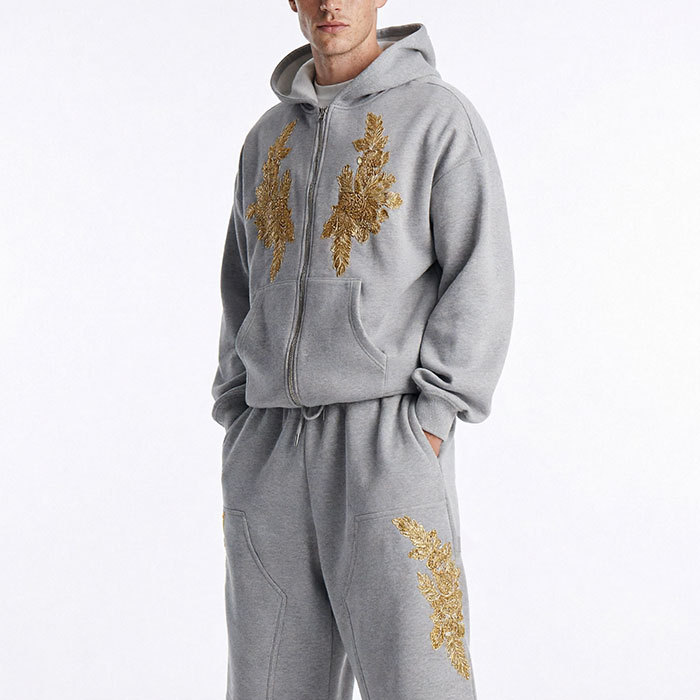
Embroidery and appliqué are the highest-risk decoration categories in premium streetwear production. A misplaced chenille letter, a puckered chest logo on a 450 GSM hoodie, or an appliqué edge that lifts after the third wash can sink an entire seasonal drop. Yet many brands evaluate decoration manufacturers using the same checklist they use for basic cut-and-sew factories, which is a fundamental category error. An embroidery and appliqué streetwear manufacturer must be assessed on stitch density control, appliqué alignment systems, chenille embroidery capability, stitch stress testing protocols, panel alignment for multi-patch construction, and multi-material shrinkage management. This guide provides a technical evaluation framework that creative directors and product developers can apply during factory audits, sample comparison, and bulk production monitoring. Every recommendation is grounded in observable production behavior, not marketing claims.
Key Takeaways for Creative Directors Evaluating Decoration Manufacturers
- Density control separates specialists from generalists. Factories that cannot articulate their stitch-density range per fabric weight are not decoration-ready.
- Chenille embroidery is a separate craft tier. Most factories lack the dual-feed chenille machines and yarn-handling expertise required for consistent plush lettering.
- Appliqué alignment is a tooling problem, not a skill problem. Demand to see the factory's alignment jigs and laser positioning systems.
- Stitch stress testing must simulate 30+ wash cycles. AATCC 135 and ISO 6330 protocols are the minimum acceptable testing framework.
- Panel alignment for varsity jackets requires multi-material construction experience. Wool bodies, leather sleeves, and chenille patches shrink at different rates.
- First-wash failure is the most common decoration defect. Pre-production wash testing is non-negotiable for any bulk order.
Why Does Complex Embroidery and Appliqué Require a Specialist Manufacturer?
General sewing factories stitch garments together. Decoration specialists engineer thread, fabric, and backing into a single structural system. The distinction matters because embroidery and appliqué introduce concentrated mechanical stress into fabric panels that were not engineered to receive it. A 50,000-stitch chest logo on a 400 GSM French terry hoodie forces thousands of needle penetrations into a 15-centimeter area, creating tension that can warp the panel, compress the fleece loops, and produce visible puckering that no amount of pressing will fix. A specialist manufacturer understands this physics problem and adjusts stabilizer selection, needle type, hooping tension, and digitizing density accordingly. A general factory does not.
The specialist distinction becomes even sharper with appliqué. Appliqué construction involves layering multiple materials — wool felt, twill, leather, chenille — onto a base fabric, then stitching through all layers simultaneously. Each material has a different thickness, stretch coefficient, and shrinkage rate. If the factory lacks multi-material construction experience, the appliqué will bubble, lift at edges, or distort after the first wash because the layered materials shrink at incompatible rates. A true embroidery and appliqué streetwear manufacturer treats every decoration as an engineered assembly, not a cosmetic add-on.
For creative directors building oversized or heavyweight streetwear lines, the risk profile is amplified by fabric weight. Heavyweight fabrics above 380 GSM behave differently under embroidery tension than lightweight jersey. The dense knit structure resists needle penetration, requiring industrial-grade machines with sufficient torque — Tajima and Barudan are the industry benchmarks — and ball-point needles designed for knit fleece to prevent runs and holes. Factories using consumer-grade or aging machines without proper torque control will produce inconsistent stitch depth, broken threads, and distorted designs. This is why evaluating a factory's machine inventory is step one of any decoration audit.
The practical takeaway: when a factory cannot describe their stabilizer selection logic, cannot show you their chenille embroidery samples, or treats appliqué as "just sewing a patch on," walk away. Decoration is a structural engineering discipline, and only specialists survive complex production at scale. Brands looking for specialist streetwear manufacturers in China should filter specifically for in-house embroidery and appliqué capability rather than outsourced decoration, which introduces quality gaps nobody can control.
What Types of Embroidery Should You Expect from a Streetwear-Ready Factory?
A decoration-capable factory should offer at minimum five distinct embroidery techniques: flat embroidery, 3D puff embroidery, chenille embroidery, chain-stitch embroidery, and appliqué-backed embroidery. Each technique serves a different design purpose and requires specific machine configurations, digitizing approaches, and quality control parameters. If a factory offers only flat embroidery, they are not a decoration specialist — they are a general manufacturer with a single-head machine in the corner. Custom embroidery streetwear demands range across all five techniques because different design elements require different tactile and visual effects.
Flat embroidery is the baseline. It handles fine detail, small text, and multi-color logos with precision down to 1-2 millimeters. The quality differentiator here is stitch density control. Low-quality flat embroidery uses excessive stitch counts to compensate for poor digitizing, producing a stiff, board-like patch that feels like cardboard and stresses the fabric underneath. High-quality flat embroidery uses density mapping — varying stitch concentration across the design — to maintain structural integrity while preserving fabric drape. Ask the factory for their density range per square centimeter. A competent answer is 3-7 stitches per millimeter depending on design complexity and fabric weight.
3D puff embroidery uses foam underlay to create raised, tactile logos. This is common in streetwear chest graphics and cap front panels. The quality risk is foam compression — if the foam density is too low or the top stitch coverage is insufficient, the raised profile flattens within 5-10 washes. A specialist factory will specify their foam grade (typically 2mm or 3mm EVA foam) and show you washed samples demonstrating profile retention. They will also explain their corner-sharpness technique, because rounded corners on 3D puff designs are the visible signature of amateur work.
Chain-stitch embroidery, often used for western-influenced streetwear and ornamental back panels, requires specialized chain-stitch machines rather than standard lockstitch heads. Many factories cannot produce chain-stitch at all. Those that can should demonstrate consistent loop tension across curves, because inconsistent tension produces visible tightness variations that destroy the flowing aesthetic. For a deeper understanding of how decoration techniques stack against printing methods, this printing and decoration playbook maps the full range of options available to streetwear brands evaluating mixed-technique collections.
How Do You Evaluate Appliqué Execution Before Committing to Bulk?
Appliqué evaluation starts with the sample, not the spec sheet. When you receive a prototype from an appliqué patch manufacturer, inspect four critical zones: edge finish, corner sharpness, material lay flatness, and stitch coverage along the appliqué perimeter. Edge finish tells you whether the factory uses proper satin-stitch sealing or relies on raw-cut fabric that will fray. Corner sharpness reveals digitizing precision — rounded corners on geometric appliqué shapes indicate the digitizer simplified the path to avoid thread breaks, which is a capability red flag. Material lay flatness is the most immediate visual indicator: if the appliqué fabric bubbles or lifts at any point, the backing and tension setup are wrong.
Stitch coverage along the appliqué perimeter is where most factories fail. The satin border stitch must fully encapsulate the appliqué edge with consistent width — typically 2-3 millimeters — and uniform density. Gaps, width variations, or loose threads along the border are structural failures, not cosmetic ones. They indicate that the machine tension was improperly set or that the appliqué fabric thickness varied beyond the machine's compensation range. In bulk production, these defects multiply exponentially because the same incorrect settings are applied across hundreds of units.
The second evaluation layer is multi-layer appliqué capability. Premium streetwear frequently uses stacked appliqué — twill base with felt overlay, or felt with chenille lettering — to create dimensional depth. Each additional layer compounds the alignment challenge. The factory must demonstrate that their alignment system — whether laser-guided, jig-based, or digital projection — can maintain registration across all layers within a 1-millimeter tolerance. Request a multi-layer sample and measure the offset between layers at four points. Anything beyond 1.5 millimeters is unacceptable for premium positioning.
The third evaluation layer is wash testing the appliqué sample yourself before approving bulk. Run the sample through five full wash cycles — cold water, 30 degrees Celsius, tumble dry low, inside out. Then inspect for edge lift, fabric shrinkage differential between the appliqué and the base garment, thread tension relaxation, and color bleed from appliqué fabric into the base. A factory confident in their appliqué execution will have already run this test and can provide the washed sample alongside the unwashed one. If they cannot, their quality system does not include decoration durability testing, and you are assuming that risk.
Why Is Chenille Embroidery a Separate Craft Tier That Most Factories Cannot Handle?
Chenille embroidery is not flat embroidery with fuzzy thread. It is a fundamentally different mechanical process that uses a dual-feed system: one needle applies the chenille yarn in a looped chain-stitch pattern while a secondary mechanism cuts the loops to create the characteristic plush, velvety surface. This requires specialized chenille embroidery machines — not standard multi-head flat embroidery machines with a different thread. The most common industry machines are TMCC, Multi-Head Chenille, or combination flat-chenille units from Tajima and Barudan. A factory that claims chenille capability but cannot identify their chenille machine model is outsourcing the work or misrepresenting their capacity.
The quality challenges in chenille embroidery hoodie production are density consistency and yarn management. Chenille yarn is thick, textured, and prone to tension variation. Inconsistent tension produces visible density patches — some areas plush and full, others flat and sparse — that are immediately detectable by touch and eye. A specialist chenille operator calibrates yarn tension for each color change and monitors density across the production run. Most factories do not have operators with this training, which is why chenille letters from non-specialist factories look uneven, patchy, or flat in random sections.
Chenille is also the highest-risk decoration for wash failure. The plush yarn surface is structurally vulnerable: if the chain-stitch loops are not properly locked, washing abrasion will pull loops loose, creating a frayed, matted appearance that destroys the premium look. Pre-production wash testing is even more critical for chenille than for flat embroidery. Demand to see a chenille sample that has been through at least 10 wash cycles. If the plush surface maintains consistent density and no loops have loosened, the factory's chenille process is production-ready. If not, no amount of bulk pricing makes the risk acceptable.
Info Box — Chenille Capability Audit: When auditing a factory for chenille capability, ask three questions: (1) What chenille machine model do you operate, and how many heads? (2) Can you show me a chenille sample that has been wash-tested 10+ cycles? (3) What is your chenille yarn supplier and denier specification? If any answer is vague or absent, the factory does not have genuine in-house chenille capability. Chenille outsourced to a subcontractor cannot be quality-controlled in real time during bulk production.
What Stitch Stress Tests Should You Demand for Embroidered Streetwear Pieces?
Stitch stress testing is the single most skipped quality step in streetwear decoration manufacturing, and it is also the most consequential. The industry-standard protocols are AATCC 135 (Dimensional Changes of Fabrics after Home Laundering) and ISO 6330 (Domestic Washing and Drying Procedures for Textile Testing). These protocols specify wash temperature, cycle duration, agitation level, and drying method to simulate real consumer laundry behavior. A competent embroidery and appliqué streetwear manufacturer will run accelerated wash tests equivalent to 30-50 home laundry cycles on every new decoration combination before approving bulk production. If the factory cannot produce wash test documentation, they are guessing, not testing.
The specific metrics that stitch stress testing should track are: thread tensile strength retention, embroidery distortion (measured as percentage of dimensional change in the embroidered area), backing integrity (no delamination or separation from fabric), color fastness of embroidery thread (rated on the AATCC gray scale, minimum Grade 4), and appliqué edge adhesion (percentage of perimeter remaining fully sealed). Industry data shows that polyester embroidery thread with proper backing and optimized tension retains 95-99% structural integrity after 50 equivalent wash cycles. Rayon thread, by contrast, shows visible fading and tensile degradation by cycle 15-20. The factory should specify their thread material and justify the choice based on the intended wash frequency of the garment.
Beyond standardized wash testing, there are two additional stress tests that decoration specialists should perform. The first is abrasion testing using a Martindale or Wyzenbeek apparatus, which simulates the friction a garment experiences during wear. Embroidery on high-contact zones — chest, shoulder, back panel — must survive 5,000-10,000 abrasion cycles without thread breakage or density loss. The second is stretch recovery testing, critical for appliqué on knit fabrics. The embroidered panel is stretched to 120% of its resting dimension, released, and measured for recovery. If the appliqué distorts permanently or the embroidery puckers after stretch recovery, the decoration will fail during real-world wear.
The actionable recommendation: make wash test documentation a contractual precondition for bulk production approval. Specify in your purchase order that the factory must provide photographs and measurements of the embroidered sample before and after 30 wash cycles per AATCC 135 protocol. This shifts the testing burden to the factory — where it belongs — and creates a documented quality baseline that protects both parties if decoration defects appear in bulk. For brands that want to understand how quality control systems should be structured across the entire production pipeline, the quality control framework for embroidery and appliqué production breaks down each checkpoint from fabric inspection through final shipment audit.
How Does Fabric Weight Affect Embroidery Density and Appliqué Alignment?
Fabric weight is not a passive variable in decoration — it is an active engineering constraint. A 260 GSM hoodie and a 500 GSM hoodie require completely different embroidery parameters. On lightweight fabrics (180-260 GSM), excessive stitch density creates what the industry calls the "bulletproof vest" effect: the embroidered area becomes stiff and rigid because the thread concentration overwhelms the fabric's structure. On heavyweight fabrics (380-500+ GSM), insufficient density produces designs that look sparse, uneven, and visually weak because the thick knit absorbs and hides stitches. The factory must adjust density mapping for each fabric weight, and this requires a digitizing team that understands the relationship between stitch count, fabric GSM, and visual saturation.
The stabilizer selection changes with fabric weight as well. For designs exceeding 30,000 stitches on heavyweight fleece, cut-away stabilizers are mandatory. Tear-away stabilizers — which are cheaper and faster to remove — do not provide sufficient structural support for high-stitch-count designs on dense fabrics. After one wash cycle, the tear-away backing fragments and the embroidery loses its foundation, producing the characteristic "waving" or rippling effect that signals amateur production. A factory that defaults to tear-away stabilizers for all jobs is cutting corners on material cost at the expense of decoration longevity.
Appliqué alignment is also weight-dependent. On heavyweight fabrics, the base material provides a stable platform that resists distortion during appliqué stitching. On mid-weight fabrics (280-340 GSM), the base is more prone to stretching and shifting during hooping, which throws appliqué alignment off by several millimeters across a production run. This is why varsity jacket appliqué on heavy wool melton bodies achieves better registration precision than appliqué on lightweight nylon shells. The factory must account for fabric weight when setting up their alignment jigs and hooping protocols. If they use the same setup for a 260 GSM hoodie and a 500 GSM hoodie, alignment defects are guaranteed on the lighter weight.
Shrinkage is the hidden variable that ties fabric weight to decoration failure. A 100% cotton 400 GSM hoodie can shrink up to 8% if not properly compacted before cutting. When the base fabric shrinks but the polyester embroidery thread does not, the embroidery warps, bubbles, or distorts. Pre-shrinking through mechanical compacting reduces fabric shrinkage to under 3%, which keeps the dimensional differential between thread and fabric within tolerable limits. For heavyweight hoodies and sweatshirts where decoration is central to the product's value, specialized hoodie manufacturing with integrated pre-shrinkage protocols ensures that embroidery and appliqué remain dimensionally stable through the garment's lifecycle.
Why Do Most Embroidery Failures Appear After the First Wash Cycle?
First-wash failure is the decoration industry's most common and most damaging defect category. The reason it occurs after washing — and not during production — is that washing introduces three simultaneous stress factors that the decoration did not experience on the factory floor: moisture absorption, mechanical agitation, and thermal expansion. Cotton base fabric absorbs water and swells, polyester thread does not. The agitation of a washing machine pulls on every stitch from multiple directions simultaneously. Thermal expansion from warm water creates dimensional changes in both fabric and thread at different rates. These three forces combine to expose any weakness in the decoration's structural engineering.
The most visible first-wash failure is puckering. Puckering occurs when the embroidery thread contracts against a base fabric that has expanded or shifted during washing. If the stabilizer backing is insufficient — either too lightweight or a tear-away that has partially disintegrated — there is nothing holding the fabric flat under the stitched area. The thread pulls the fabric into wrinkles around the design perimeter. Once puckering appears, it is permanent. No amount of ironing or pressing will restore the fabric to flat because the thread tension has permanently deformed the knit structure. This is why stabilizer selection is not a cost decision — it is a structural integrity decision.
The second common first-wash failure is appliqué edge lift. This happens when the adhesive or bonding agent used to tack the appliqué fabric to the base garment before stitching dissolves or weakens in water. If the satin border stitch is the only thing holding the appliqué down — without adequate adhesive backup — moisture and agitation will work the fabric edges loose within 3-5 washes. The factory must specify whether they use heat-activated adhesive, sew-only attachment, or a combination. Heat-activated adhesive alone is insufficient for premium products; it must be combined with complete perimeter stitching for structural redundancy.
The third failure mode is color bleed. On dark base fabrics with light embroidery thread — a common streetwear combination like black hoodie with white logo — inferior dye fastness in the base fabric causes dye to migrate into the embroidery thread during washing. The white logo takes on a gray or tinted hue after the first wash. This is preventable through Level 4 color fastness testing (AATCC Crocking and Washing standards), which any decoration specialist should perform as standard pre-production protocol. If the factory cannot provide color fastness test results for the specific fabric and thread combination in your design, the risk of color bleed is unquantified and unmanaged.
What Panel Construction Skills Does a Varsity or Multi-Patch Jacket Manufacturer Need?
Varsity jacket construction is the most demanding multi-material construction challenge in streetwear manufacturing. A typical varsity jacket combines a wool melton body, leather or vegan leather sleeves, ribbed knit collar and cuffs, satin lining, and multiple appliqué patches across chest, back, and sleeves. Each material has a different thickness, stretch coefficient, shrinkage rate, and sewing behavior. The factory must engineer panel seams that accommodate these differences without producing distortion, puckering, or structural weakness at the material transition points.
Panel alignment for varsity jackets is a three-dimensional problem, not a two-dimensional one. The chest patches must align with the body panels, the sleeve patches must align with the sleeve panels, and the back patches must center on the back yoke — all while the jacket is constructed from materials that shift during sewing. The factory must establish a panel alignment sequence: which panels are decorated before assembly, which are decorated after assembly, and how registration marks transfer between pre-assembly and post-assembly decoration stages. This sequence is factory-specific knowledge that separates experienced varsity jacket appliqué producers from general jacket factories attempting varsity for the first time.
The leather sleeve construction introduces another layer of complexity. Leather does not behave like woven or knit fabric — it cannot be pinned (pins leave permanent holes), it requires specialized sewing machine feet (roller or Teflon feet to prevent sticking), and it has zero stretch recovery. If the leather sleeve and wool body shrink at different rates during any post-construction processing, the seam joining them will pucker or the jacket silhouette will distort. The factory must pre-condition both materials to compatible dimensional states before assembly, and they must use seam construction techniques that allow for minor dimensional differential without visible distortion.
The ribbed knit components — collar, cuffs, and waistband — are the final panel construction challenge. Ribbed knit has significant stretch, and the factory must cut and attach it at the correct stretch ratio so the ribbing maintains its shape and function without distorting the jacket body. If the ribbing is attached at too high a stretch, it will pull the body fabric inward, creating a gathered appearance. If attached at too low a stretch, the ribbing will be loose and non-functional. For brands producing varsity or letterman jackets, working with a manufacturer that has documented multi-material jacket construction experience is essential, because the learning curve for varsity-specific panel construction is measured in production runs, not samples.
How Should You Compare Embroidery Sample Quality Across Multiple Factories?
Sample comparison across factories requires a standardized evaluation matrix, not subjective visual impressions. Too many brands choose a factory based on which sample "looks best" under office lighting, which is a fundamentally unreliable evaluation method. The correct approach is to send the identical digitized design file to three or more factories, request the same design on the same fabric weight, and evaluate the returned samples using a structured scoring system across at least six dimensions: stitch density consistency, corner sharpness, thread tension uniformity, backing integrity, fabric distortion around the embroidered area, and overall design fidelity to the original file.
Stitch density consistency is evaluated by touch and by backlighting. Run your finger across the embroidered surface — consistent density feels uniform, with no hard spots or soft patches. Then hold the sample up to a strong light source and look through the fabric from the back. Density variations appear as lighter and darker zones within the embroidered area, revealing where the digitizer or machine operator compensated inconsistently. This test exposes factories that manually adjust machine tension mid-run to compensate for digitizing errors, which is a practice that produces visually acceptable samples but fails in bulk production consistency.
Corner sharpness is the single most diagnostic quality indicator. Sharp corners — on geometric letters, logos with angular elements, or appliqué shapes — require the machine to execute precise needle positioning with controlled thread tension. Factories with aging machines or untrained operators will produce rounded corners, thread buildup at angle points, or visible needle deflection marks. Compare corner sharpness across samples using a magnifying loupe. The difference between a specialist and a general factory is immediately visible at 5x magnification.
Info Box — Sample Comparison Scorecard: Rate each factory sample 1-5 on each dimension: (1) Stitch density consistency, (2) Corner sharpness, (3) Thread tension uniformity, (4) Backing integrity, (5) Fabric distortion around embroidery, (6) Design fidelity to original file. Also wash-test all samples for 5 cycles and re-score. A factory that scores 4+ on all dimensions pre-wash but drops below 3 post-wash is masking quality with stabilizer stiffness. The post-wash score is the true quality indicator.
The final comparison factor is consistency across multiple samples from the same factory. Request two or three identical samples from each factory — not one. If a factory cannot produce consistent results across three samples, they cannot produce consistent results across 500 units in bulk. Measure the dimensional variance between samples: if the embroidered logo is 1 millimeter different in size or position across three samples, the factory's hooping and alignment system lacks the precision your brand requires. For brands seeking comprehensive decoration capability, Groovecolor's decoration craft capabilities span the full embroidery, chenille, and appliqué spectrum with documented sample-to-bulk consistency protocols.
What QC Checkpoints Separate a Decoration Specialist from a General Sewing Factory?
A general sewing factory inspects garments. A decoration specialist inspects decorations. The distinction sounds obvious, but it has profound implications for quality control architecture. A general factory's QC process focuses on seam integrity, stitch length consistency, fabric defects, and measurement accuracy — all garment-level metrics. A decoration specialist adds decoration-specific checkpoints at every production stage: digitizing review, backing selection verification, hooping tension audit, in-process stitch density monitoring, appliqué alignment verification, post-embroidery fabric distortion measurement, and wash test sampling from bulk production. These additional checkpoints do not exist in a general factory's QC system because their inspectors are trained to evaluate garments, not decorations.
The digitizing review checkpoint is where decoration specialists add the most value. Before a single stitch is sewn, the specialist reviews the digitized file against the fabric weight, design complexity, and intended decoration technique. They adjust underlay density, stitch direction, pull compensation, and fill pattern to match the specific fabric's behavior. A general factory skips this step — they send the file to the machine and accept whatever comes out. The result is decoration that looks acceptable on a sample but fails in bulk because the digitizing was not optimized for the production fabric.
The in-process stitch density monitoring checkpoint is the second differentiator. During bulk production, a specialist pulls random samples from the line at defined intervals — typically every 50 pieces — and measures stitch density against the approved sample. If density drifts beyond a defined tolerance, the machine is stopped and recalibrated. This prevents the common bulk defect where the first 100 pieces are perfect and the remaining 400 show progressive density degradation because the machine tension drifted and nobody noticed. General factories do not perform in-process decoration checks because they do not have the measurement tools or the trained personnel.
The wash test sampling checkpoint is the third differentiator. A decoration specialist pulls a random sample from finished bulk production and runs it through a wash cycle before shipment. This is the final verification that the bulk production matches the approved pre-production sample's wash performance. If defects appear, the specialist quarantines the batch and investigates root cause before shipment. A general factory ships without this checkpoint, which means wash defects are discovered by the brand's customers — the most expensive and most damaging quality failure scenario possible.
How Do You Protect Embroidery and Appliqué Integrity During Bulk Production?
Bulk production is where sample-approved quality either survives or collapses. The transition from sample to bulk introduces scale-related variables that do not exist in single-piece production: machine drift across multi-head configurations, operator changes between shifts, stabilizer batch variation, thread lot color inconsistency, and fabric roll-to-roll weight variation. Protecting decoration integrity during bulk requires a production management system that anticipates and controls each of these variables. The brand's role is to specify the controls in the purchase order and verify their implementation during production.
The first protection mechanism is the pilot run. Before full bulk production begins, the factory should produce a 10-20 piece pilot run using the exact bulk materials, settings, and operators. This pilot run is inspected against the approved sample using the same dimensional and visual criteria. If the pilot run reveals density drift, alignment offset, or material inconsistency, the issue is corrected before the remaining 480 pieces are produced. A factory that skips the pilot run and goes straight to full bulk is gambling with your decoration quality at scale — and the odds are not in your favor.
The second protection mechanism is thread lot consolidation. Embroidery thread is dyed in lots, and color variation between lots is a well-documented industry issue. For a 500-piece bulk order with a multi-color embroidered logo, the factory must source all thread for each color from a single dye lot. If they must supplement from a second lot, they must produce a color-matching verification under daylight-spectrum lighting and document the match. Mixed thread lots in a single bulk order produce visible color variation across garments that is immediately detectable on a retail rack — and immediately damaging to brand perception.
The third protection mechanism is fabric roll inspection for weight consistency. Heavyweight fabrics are manufactured in rolls, and GSM can vary by 5-10% between rolls from the same supplier. This variation affects both embroidery density appearance and appliqué alignment precision. The factory must inspect and weigh a swatch from every fabric roll before cutting, segregate rolls that fall outside the specified GSM tolerance, and adjust embroidery parameters for any roll that is approved at the tolerance boundary. This level of material control is standard for specialist heavyweight hoodie manufacturing but is absent in general factory production where fabric is cut directly from rolls without per-roll verification.
What Does a Production-Ready Embroidery and Appliqué Partnership Look Like?
A production-ready decoration partnership is characterized by three operational attributes: documented process transparency, shared quality language, and pre-agreed failure protocols. Documented process transparency means the factory provides a written production flow that specifies every decoration step, from digitizing through final inspection, with named operators and machine assignments. You know exactly who is running your embroidery, on which machine, with what stabilizer, thread, and backing. This level of transparency is standard for specialists and impossible for general factories because general factories do not have decoration-specific process documentation.
Shared quality language means both parties use the same terminology and measurement standards for decoration evaluation. The brand specifies acceptable tolerance ranges for stitch density, appliqué alignment offset, corner sharpness, and wash test performance. The factory reports against these tolerances using the same metrics. This eliminates the most common quality dispute: the brand says "the embroidery looks wrong" and the factory says "it meets our standard" — because there is no shared standard. A production-ready partnership establishes that standard before the first sample is produced.
Pre-agreed failure protocols define what happens when defects are discovered — and they will be discovered, because decoration is a high-variability process even under expert control. The protocol should specify: acceptable defect rate (typically 2-3% for decoration defects), inspection method (AQL 2.5 for major decoration defects), remediation process (re-embroidery, patch replacement, or unit rejection), and cost responsibility for remediation. Without pre-agreed protocols, defect resolution becomes a negotiation that delays shipment, damages the relationship, and often results in the brand accepting substandard product because the alternative is missing a delivery deadline.
The final attribute of a production-ready partnership is the factory's willingness to invest in your specific decoration challenges. A true embroidery and appliqué streetwear manufacturer will develop custom solutions for unique design requirements — a new chenille yarn weight for a specific texture, a custom appliqué alignment jig for an unconventional patch shape, a modified wash test protocol for a garment with mixed decoration techniques. This willingness to engineer solutions, rather than simply execute standard processes, is what separates a manufacturing partner from a manufacturing vendor. For brands building oversized or heavyweight streetwear lines with complex decoration, the partner relationship — not the per-unit price — is the primary determinant of long-term product quality and brand consistency.
Frequently Asked Questions
What is the minimum order quantity for custom embroidery streetwear production?
For embroidery and appliqué production, the typical MOQ is 50-100 pieces per color per style. Embroidery has relatively low setup cost because digitizing is a one-time expense, but appliqué requires cutting dies or laser-cut templates that increase setup investment. Chenille embroidery may require higher MOQs (100+ pieces) due to machine setup time and yarn minimums.
Can I mix embroidery, chenille, and appliqué on the same garment?
Yes, mixed decoration is common in premium streetwear — for example, a varsity jacket with chenille lettering, flat embroidery details, and twill appliqué patches. However, mixed decoration requires a factory with all three capabilities in-house and a production sequence that accounts for each technique's specific requirements. Outsourcing any technique to a subcontractor introduces quality control gaps that cannot be closed.
How do I verify a factory actually has chenille embroidery capability?
Ask for the chenille machine model and number of heads, request a wash-tested chenille sample (minimum 10 cycles), and ask about their chenille yarn supplier and denier specifications. If the factory cannot answer these questions immediately or needs to "check with the production team," they likely outsource chenille to a subcontractor and cannot guarantee real-time quality control during bulk production.
Ready to Evaluate a True Decoration Specialist?
If your streetwear line demands embroidery density control, chenille embroidery, appliqué alignment precision, and stitch stress testing that survives 30+ wash cycles, the conversation starts with a technical audit — not a price quote. Share your design files, fabric specifications, and decoration requirements. Receive a production-ready sample with documented wash test data.
Start Your Decoration Sample ProjectGROOVECOLOR is a leading large-scale OEM streetwear manufacturer in China, focused on premium men's custom streetwear, oversized fits, heavyweight fabrics, and complex decoration execution. For embroidery and appliqué streetwear manufacturer topics, our team looks closely at stitch density, appliqué alignment, chenille embroidery, panel construction, and decoration durability before bulk production.
The evaluation method prioritizes decoration-specific risks such as embroidery puckering, appliqué edge lift, thread stress under wash cycles, chenille density consistency, and multi-material shrinkage. Where useful, the article references common apparel quality checkpoints and publicly available embroidery testing standards so the conclusions stay grounded and verifiable.